
See why pairing quote (CPQ) and contract (CLM) software shortens sales cycles, cuts document errors, and turns quote-to-contract into one workflow.
Every sales cycle has two documents that decide whether a deal closes: the quote and the contract. Most companies produce them in two disconnected systems — a CPQ or spreadsheet for the quote, Word and email for the contract — and pay for the gap in re-keyed data, pricing errors, and deals that stall for weeks waiting on signatures.
This article explains why quote software (CPQ) and contract software (CLM) belong in one connected workflow, and the concrete gains you get when they share the same data: shorter sales cycles, fewer errors, and a cleaner path from opportunity to signed contract.
New to these categories? If you first want the plain definitions and a side-by-side comparison, read contract vs. quotation software: what you should know. This guide assumes you know roughly what each does and focuses on why to combine them.
Quote and contract software in one minute
- CPQ (Configure, Price, Quote) helps reps build accurate, on-brand quotes in a few clicks by pulling products, services, and pricing rules from a central catalogue. It removes manual price-quantity errors and enforces discount limits before an offer ever reaches the customer.
- CLM (Contract Lifecycle Management) streamlines everything that happens once terms are agreed: drafting from approved templates, approvals, negotiation, e-signature, storage, and renewals.
CPQ owns the offer; CLM owns the agreement. The value appears when the offer becomes the agreement without anyone retyping it — which is exactly why the two categories are converging in modern sales tech stacks.
Why sales cycles get shorter when the two are connected
Sales cycles vary widely by business model, but they share a pattern: most of the elapsed time is waiting — waiting on a rebuilt quote, on legal to draft, on approvals, on signatures. Connecting quote and contract software attacks that waiting time directly. The sections below break down where the time and errors actually go.
1. Every quote and contract looks professional — automatically
Drafting and managing contracts takes time and care, and a surge of new deals is often exactly when that care slips. CLM software standardises creation, drafting, and management on templates and guidelines refined over time — so even when reps are pulled in ten directions, the output stays consistent.
Contracts created in top.legal always match your corporate identity, and a guided drafting assistant ensures only the clauses that fit the specific scenario make it into the document. The quote a customer received and the contract they sign carry the same terms and the same brand.
2. Reps only sell what you actually offer — at the right price
Traditional quote-to-cash processes struggle to guarantee that reps sell products the company actually offers, at prices it actually approves. Reps default to the products they know best — sometimes ones that are no longer available — and with a broad catalogue, some items must be bundled while others can't be combined at all. Add a complex pricing structure and matching the right product to the right price by hand becomes genuinely hard.
Quote and contract software cut through that complexity. With product lists, related services, and unit prices maintained centrally in the software, individual errors drop close to zero: the rep selects the product, and the correct services and parameters flow automatically into the quote and then the contract. Discount limits are enforced up front, so nothing has to be caught and corrected after the document has already gone to the customer.
3. Offers and contracts get signed electronically — without the chase
Drafting a contract can take a few hours; getting it signed can take days or weeks, depending on the number of signatories and your compliance policies.
When quote and contract software drive the process, everyone involved is notified automatically as soon as a new draft is ready. The embedded electronic signature lets every party sign on time — no chasing signatories one by one over email, no printing and scanning.
4. Changes and renegotiations stay in one document
Contracts change constantly during a deal — a simple rewording here, a substantive clause edit there. Without software, each round means reopening a Word file, entering changes, and emailing it back. The familiar email ping-pong begins, and the "current" version is anyone's guess.
Contract software collapses that cycle: comments and edits happen directly in the same document, so there is a single source of truth rather than changes buried in inboxes and handwritten notes. Recurring edits can be pre-empted in the template itself with alternative clauses and built-in explanations, so the same negotiation doesn't have to be re-litigated on every deal.
5. Renewals stop slipping through the cracks
Managing renewals manually is thankless work: you have to dig deadlines out of each contract, watch them, and act in time. Miss one and it either auto-renews unwanted or lapses when you needed it.
With contract software, you set reminders when the contract is created or negotiated, so every deadline stays visible. When a date approaches, you get an email reminder — and the document you need for the renewal is a click away rather than a fresh drafting project.
How CLM, CRM, and CPQ software work together
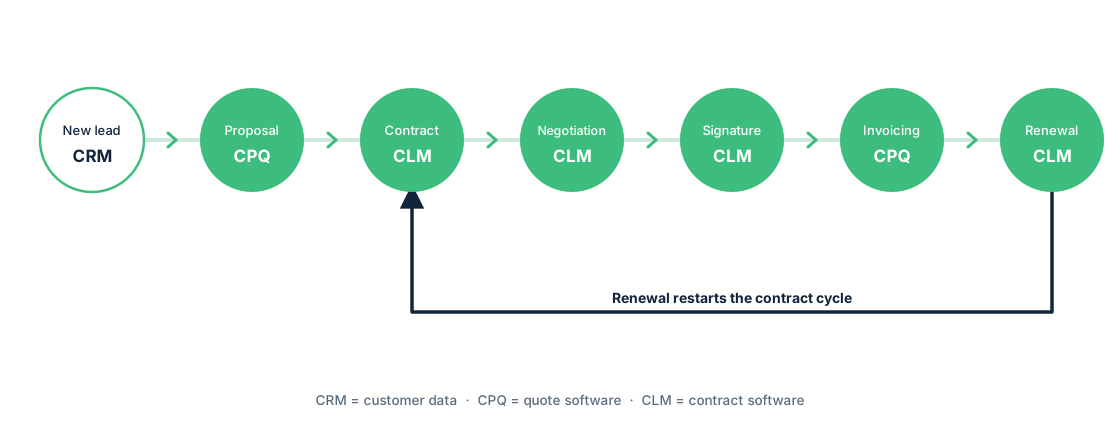
Most companies manage customer data in a CRM (Customer Relationship Management) system. CPQ and contract (CLM) software typically read from that CRM and write finished contracts and documents back into it, so the record of the deal stays complete.
Where a company doesn't want to rely on the quoting features often bundled into the CRM, a dedicated CPQ system prepares the offer. The CLM system then takes the parameters from that offer and combines them with liability terms, contract duration, and other legal provisions; the finished quote can even be embedded in the contract via a link. The result is a continuous chain — CRM to quote to contract to signature — with no manual hand-offs in between.
You can, of course, run a business without any of these systems. But as demand rises, so does the probability that errors creep into quotes and contracts — frustrating customers, quietly building up legal risk on your own side, and leaving revenue on the table through weaker deal control. Connecting quote and contract software is how growing sales teams keep speed and accuracy at the same time.
If you're still weighing whether to invest at all, our guide to contract management software covers what CLM does, what to look for, and how to build the business case.
See how top.legal turns an agreed quote into a signed contract in one workflow — standardised drafting, approvals, and e-signature without the email ping-pong.
Ready for the next step?
Book a demo with our team and see top.legal in action