
Contracts are among the most valuable documents a company owns – yet all too often they vanish into email inboxes or dusty filing cabinets. Many organisations fail to manage contracts properly after signing. Contract documents frequently go unfiled, are filed incorrectly, or are only partly stored, so
Why a central contract repository is indispensable today
Contracts are among the most valuable documents a company owns – yet all too often they vanish into email inboxes or dusty filing cabinets. Many organisations fail to manage contracts properly after signing. Contract documents frequently go unfiled, are filed incorrectly, or are only partly stored, so when they are needed they cannot be found. The result: wasted time searching for or reconstructing contracts, and the loss of valuable insights from previous deals. Without a clear structure in contract management, you risk inefficient processes, missed deadlines and costly mistakes.
A unified, digital contract archive – the contract repository – allows all contracts to be managed centrally and securely. The benefits are many: every agreement sits in one clear location, creating transparency and ending the chaos of scattered storage. Consistent filing structures and naming conventions ensure that no one accidentally works with outdated versions. A digital repository also enables fast access through search instead of endless folder clicking, increases data security, and makes it easier to meet deadlines through automated reminders. In short: a solid contract repository is now indispensable for managing contracts efficiently, in a legally sound way and across teams – and it is the foundation for professional contract management in the modern, digital workplace.
What is a contract repository?
A contract repository (also called a contract database or digital contract archive) is a central digital system in which all of a company's contracts are stored, organised and managed securely in one place. Unlike simple folder structures or Excel lists, a contract repository acts as the "single source of truth" – the only valid source for every contract document. This ensures that everyone always works with the most current version of each contract and that all parties involved are on the same page.
Compared with classic file or folder management, a contract repository offers additional capabilities: it stores far more than PDFs in some directory – it holds a wealth of contract information, from digital signatures to comments and notes through to metadata such as contract type, parties, terms, amounts and deadlines. Thanks to this "data about the data", a contract repository can do much more than a conventional folder: it enables targeted searches, filtering and reporting, so you can find a contract even if you only remember the counterparty or a keyword. Modern repository solutions often use technologies such as OCR (optical character recognition) and even AI to make scanned contracts searchable and automatically identify key content. In short: a contract repository is your digital contract archive – one that delivers more overview, security and efficiency than any manual filing system ever could.
Goals of a modern contract repository
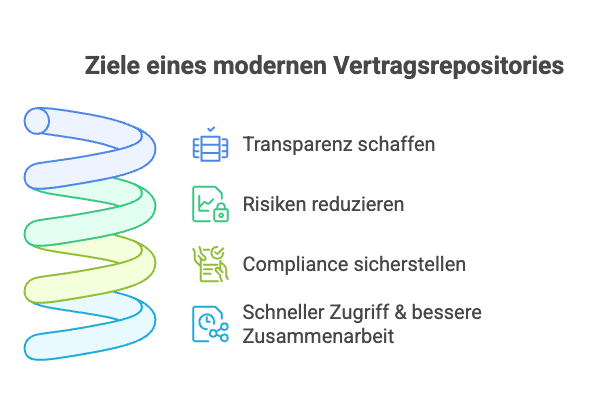
A well-built contract repository serves several important goals that go beyond simple storage:
- Creating transparency: All contracts are bundled in a central location, ensuring complete oversight. No one has to spend time searching or piecing information together from various sources – every contract is searchable and accessible from anywhere, eliminating the time-consuming hunt for scattered files. This transparency helps decision-makers keep a full view of rights, obligations and deadlines at all times.
- Reducing risk: When contracts are stored without structure, there is a real danger of overlooking important obligations or missing deadlines. A central repository significantly reduces that risk. It improves visibility of all key agreements and can even check contracts automatically for compliance. With audit trails and reminder systems, problems can be spotted early, so missed obligations or contract breaches become a thing of the past. Overall, control over contract risk increases.
- Ensuring compliance: A modern contract repository helps you meet internal policies and legal requirements. All relevant documents and evidence are archived in an audit-proof manner and can be retrieved quickly in the event of an audit. Automated checks and notifications ensure that no clause and no obligation falls through the cracks – the repository acts as a kind of watchdog, nudging the team about upcoming deadlines or required actions. That way your contract management stays compliant and audit-ready at all times.
- Fast access and better collaboration: In the era of remote work and agile teams, a central repository lets every authorised user access the contracts they need at any time – whether they sit in sales, procurement, legal or management. At the same time it fosters cross-functional collaboration, because everyone works with the same up-to-date documents. Version confusion and "my folder vs. your folder" problems disappear. Features like simultaneous editing, commenting and tracked changes ensure that everyone pulls in the same direction. The net effect: faster processes and a noticeable boost in productivity when working with contracts.
Foundations for building a repository
Before you dive in and dump hundreds of contracts into a new system, you should clearly define a few foundations. They form the basis for a sustainable contract repository:
- Clear data and folder logic: From the outset, think through a sensible structure for filing and organising contracts. For example, you might split by department (sales, procurement, HR, etc.), by contract type (customer contracts, supplier contracts, NDAs, employment contracts) or by project/product. Whichever you choose – stay consistent! A uniform folder or tag structure means people can find their way around later. The principle: categorisation is the key to fast access. Each contract should sit exactly where (or be tagged exactly as) you would intuitively expect to find it.
- Uniform naming and metadata standards: Wildly varying file names or inconsistent labels make searching enormously difficult. So define firm naming conventions. For example, the file name could always include the date, contract type, partner and version number, so contracts can be sorted easily by chronology and content (e.g. 2025-12-01 Services_Agreement_ACME_v1.pdf). Just as important: decide which metadata to capture for each contract (e.g. contract type, parties involved, start and end dates, notice period, contract value, responsible person, and so on). It is this uniform data that makes the repository truly searchable and analysable. The cleaner and more consistent your standards, the more useful the archive. (Tip: at the start, put together a short guideline or doc so everyone knows how contracts should be named and tagged.)
- Roles and permissions: Not every employee should be able to see or edit every contract. Plan a suitable permissions model. Who needs read access and who needs edit rights? Typically, the legal team will have full access, while business units only see the contracts in their area. Set up roles (such as administrator, lawyer, buyer, sales rep) and define clear responsibilities for maintaining the archive. It is crucial to have people who take responsibility for ensuring new contracts actually make it into the repository and that the data stays current. Without those clear ownership lines, even the best system will fail, because no one feels accountable for keeping the contract data clean. So: decide early on who is allowed to do what and who looks after which tasks (e.g. regular archiving, data entry, permissions management).
Best practices: how to build an effective contract repository
Once the foundations are in place, it is time to execute.
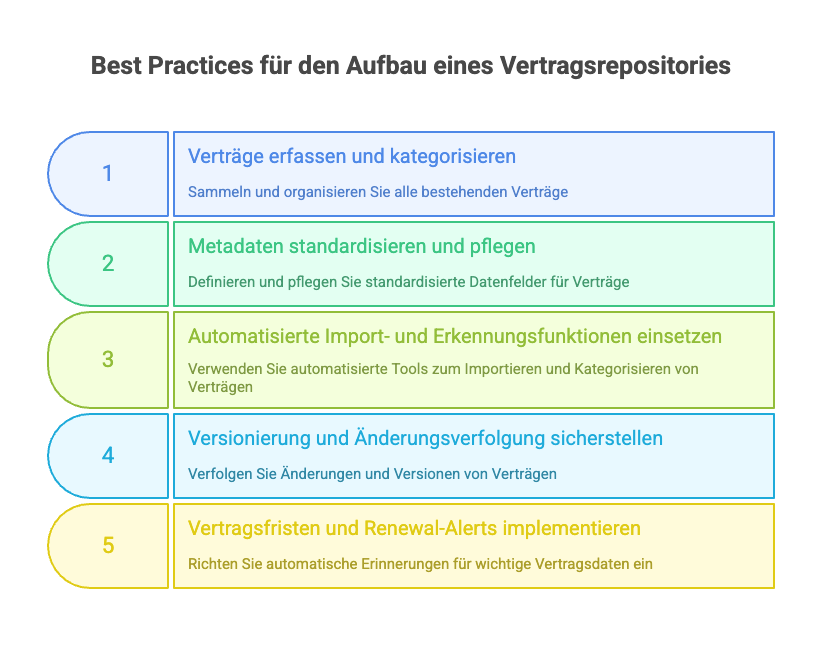
The following best practices have proven their worth in turning a simple contract archive into a genuinely efficient and effective contract repository:
- Capture contracts completely and categorise them systematically: Start by taking inventory of every existing contract in the company. Comb through all storage locations – whether scattered across network drives or sitting in folders in a cabinet – and bring every contract document together in one place. Each department should contribute its contract holdings. Then transfer that mass of documents into the new structure: assign every contract to the right category (e.g. by contract type or department, as defined above). Duplicates and outdated versions can be weeded out, and legacy paper contracts should be digitised wherever possible. That way you make sure no important contract slips through. This initial effort pays off, because only a complete repository delivers the 360-degree view you are after. From now on, file new contracts directly in the repository as a matter of course so the data set stays current.
- Standardise and maintain metadata: The real power of a contract repository lies in its metadata. Define standardised data fields for each contract and fill them in diligently – ideally based on the standards you set earlier. Typical metadata includes contract type, contract number, parties, start and end dates, notice terms, payment volume, automatic renewal yes/no and so on. Uniform metadata lets you filter contracts later in a targeted way (for example, all active supplier contracts above amount X with an end date in the next quarter). Automation can take a lot of work off your hands here: modern systems often recognise key figures automatically on upload. AI-powered solutions can, for instance, extract contract type, party names, currency, renewal clauses or deadlines directly from the PDF and store them as tags. Use such features wherever possible – they save time and reduce data-entry errors. The important thing is that all required metadata sits complete and correct in the system, so no critical detail slips through later.
- Use automated import and recognition features: Say goodbye to manual filing processes wherever you can. An efficient repository takes routine work off your plate. For example, the solution should be able to import new contracts automatically, whether via email forwarding or drag-and-drop upload, and apply OCR at the same time so scanned documents are searchable too. As mentioned, artificial intelligence can help with metadata capture – it recognises contract numbers, names, dates and so on by itself. Many modern contract-management systems can also categorise contracts automatically, based on templates or keywords. These intelligent import and recognition features ensure your repository stays up to date without anyone having to name and file PDFs by hand. The motto: automate as much as possible so your team can focus on content work rather than data entry.
- Ensure versioning and change tracking: A central contract repository should master version control – and you should use that feature consistently. Every change to a contract, every amendment and every new negotiation version must be traceable in the system. That way you keep the history of a contract in view and always work with the current version. Good repository tools allow you to inspect older versions and understand differences. This avoids confusion and keeps the entire team on the same page. In a dispute or when questions arise, you can check at any time what the original contract said or who made which change and when. This traceability builds trust and prevents errors that could arise from using outdated documents.
- Implement contract deadline and renewal alerts: One of the biggest benefits of a digital contract archive is automatic deadline management. Be sure to set up reminder systems that keep important dates in view – whether it is a notice date, a renewal option or an indexation deadline. The repository should alert you and the responsible employees in good time, for instance 30, 60 or 90 days before a contract expires or automatically renews. Such contract alerts are essential to never miss a deadline again. The system acts like a safety net: it proactively reminds you of upcoming notice windows or renewals and gives you enough lead time for negotiations. That stops contracts from sliding "under the radar" into automatic renewal or quietly running out – nasty surprises in the form of contract penalties or unplanned extensions are prevented. Automated deadline monitoring reduces risk and ensures your team always stays ready to act.
Integration with existing systems
A contract repository unlocks its full value only when it is not left as an isolated island, but is seamlessly integrated into your existing software landscape. Interfaces to other tools are therefore a decisive factor when building one. Modern contract-management platforms can typically connect with CRM, ERP, CLM or DMS systems. What does that mean in practice? Your contract data can be exchanged automatically with, for example, the CRM (customer management), the ERP (inventory/finance system) or a document management system. The advantages are obvious: no more double data entry, fewer manual transcription errors, and consistent data across departmental boundaries.
Imagine a sales rep closes a deal in your CRM – ideally a draft contract should be created in the repository right away. Or the repository could push a notification to the ERP as soon as a contract is renewed, so the finance team can adjust its budget planning. Through such integrations, the contract repository becomes the central single source of truth for contract-relevant information across the company. Information silos disappear, and everyone works with the same current data. It also saves time: teams no longer have to dig through different applications to find contract details, but can pull the information they need from the integrated repository at any time. In short: an integrated contract repository makes your entire IT landscape more efficient and more intelligent, because contracts feed into every important business process as a data source.
Common mistakes when building a contract repository
When introducing a contract repository, there are a few pitfalls worth knowing about. Here are some common mistakes – and how to avoid them:
- Too many manual processes: If the repository ends up as nothing more than a digital filing cabinet that you still have to feed entirely by hand, you are throwing away a lot of potential. Manual data entry and hand-maintained data are error-prone and time-consuming. A frequent mistake is skipping automation. How to avoid it: use the technical possibilities at your disposal – automated imports, AI-driven tagging, templates and workflows. The more routine work the system handles, the less "busy work" for your team – and the lower the risk of mistakes.
- Missing ownership: A repository without clear owners is like a ship without a captain. Companies often forget at launch to decide who maintains and oversees the system. As a result, no one really feels responsible – and in the worst case the repository is run sloppily or not kept current. How to avoid it: from the start, define who administers the contract repository (e.g. a single person or a small team from legal/ops) and who serves as the contact point in each department. These "repository champions" make sure contracts actually land in the system and that questions get answered. Clear roles and training drive adoption and proper use.
- Unclear structure: A common mistake is to just start saving documents with no consistent logic. If every employee creates folders or names contracts however they please, chaos quickly takes over – and the digital archive becomes unusable. How to avoid it: work out a folder and category scheme in advance (see the foundations section) and communicate it to every user. Keep the structure as simple as possible. And, crucially: discipline! Everyone has to stick to the agreed rules, otherwise even the best plan is worthless.
- No automated deadline monitoring: One of the gravest mistakes is to leave deadline and date tracking to chance or human memory. Anyone who tracks contract renewals by word of mouth or in a loose Excel list will inevitably miss dates. How to avoid it: switch on the repository's built-in alert features (or connect it to calendar/reminder tools). Better one reminder too many than too few. Missed notice periods can cause enormous costs – a lesson many companies have had to learn the hard way. So: configure the system rigorously so that no deadline goes unwatched.
Real-world examples and success factors
How are modern companies actually using a contract repository, and what makes them successful? A clear pattern emerges: cross-functional use is a key factor. A contract repository is not just a tool for the legal team – it serves every team as a shared platform. For example, one global company with hundreds of contracts migrated its previously scattered documents into a central cloud database. The result: every department can now find and analyse the contracts they need in seconds. The legal team keeps oversight of active obligations and clauses, while the procurement team can filter supplier contracts by performance and tackle renewals in good time. The finance team, in turn, taps into payment and term data to plan cash flows and handle audits. This interplay across stakeholders through a shared repository drives enormous efficiency gains and lowers risk, because nothing slips through the cracks any more.
Another success factor is a set of must-have features that keep a contract repository efficient over the long run. These include powerful full-text search (so you can locate clauses or keywords inside contracts instantly) and filtering by metadata (e.g. all contracts with partner X, or every contract expiring next year). Equally essential is the automated deadline reminder already mentioned – not a must-have but an absolute must. Also important: version control and access history to track changes gap-free, plus a role-based permissions system that protects sensitive contracts. Integrated reporting and dashboard functions help you capture key metrics such as contract volumes, upcoming renewals or compliance status at a glance. And, not least, a modern repository should be easy to use – because only when every user enjoys working with the system will you reap its full benefits. Many successful companies appoint internal "contract managers" or key users who keep operations running smoothly and support the team with questions. With the right features and the right people on board, the contract repository becomes a long-lived success and a genuine knowledge base for your company.
Ready for the next step?
Book a demo with our team and see top.legal in action