
Contract templates are standardized templates that are supplemented with specific contractual partner information. Learn how they enable access to more employees, reduce errors, accelerate contract closing, improve collaboration, and ensure maximum consistency.
In today's complex and fast-moving business environments, contract creation has to be quick and easy. Instead of worrying about the right legal wording, contract templates give everyone involved the assurance that the language is correct – freeing them to focus on the business terms that actually matter.
What Is a Contract Template?
A contract template is a standardized model for an agreement. It is filled with the contracting parties' information and used as a finished contract. Templates are mainly used where the same agreement applies to different situations and only needs minimal adjustment.
The impact of automating a seemingly small step often comes as a surprise: simply digitizing contract creation can lead to considerable savings.
With one exception – where all of an organization's offers are extremely specific and individual – practically every company benefits from contract templates. Their use is faster and more automated, and therefore leads to fewer errors.
The five advantages below sum up why the switch is worth it.
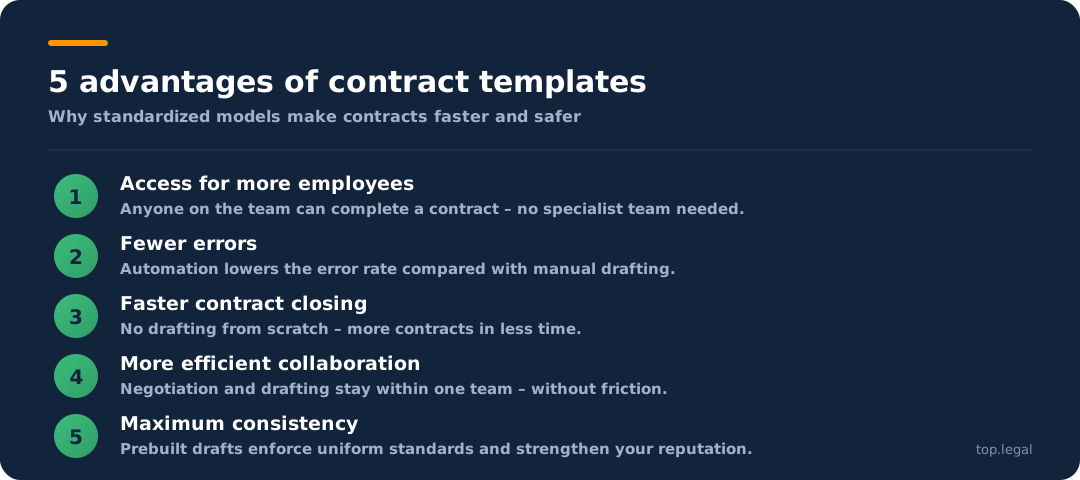
Benefit 1: Access for more employees
With prepared contract templates, virtually any employee can complete a contract: they enter the missing party-specific details (name, address and so on) and close the deal. A highly qualified team dedicated solely to drafting is no longer necessary.
This keeps negotiation and drafting within the same team. There's no hand-off at which important matters or negotiation details get lost because they weren't discussed clearly enough with a separate drafting team.
Benefit 2: Lower risk of errors
Every task carried out manually is more error-prone than an automated one. On top of that, repetitive, monotonous work weakens concentration, and the motivation to double-check for accuracy is limited.
With contracts, though, even a small typo can cause significant problems – and this is exactly where automation through templates helps. When the framework and text are already in place and only the decisive information needs to be entered, the risk of error drops sharply.
Benefit 3: Faster contract closing
Contract templates produce more closings, and produce them faster. For one, the contract doesn't have to be drafted from scratch each time, and pages-long documents otherwise cost considerable time. For another, aggregate data builds up over time, providing the basis for an error analysis.
That makes it possible to identify which clauses trigger too much discussion, which have already caused a deal to fall through, and which are unclear and should be reworded. Templates can therefore be improved continuously. This saves even more time, leads to more closings and raises the satisfaction of contracting partners – which indirectly feeds into company profit.
Benefit 4: More efficient collaboration
What's tried and tested is often simply better.
It is generally more efficient to task a team once with creating well-thought-out, worked-out templates that can then be continuously refined using error analysis.
Without uniform templates, every employee would have to draft their own contract before closing. For reasons of time and resources, this often produces a hasty, sloppy document – avoidable from the outset.
The time freed up by that one-time automation effort can be invested by employees in other valuable tasks and put to better use.
Benefit 5: Maximum consistency
With prebuilt draft contracts, typical corporate standards are enforced by default. The risk that employees build in their own version of company rules when drafting manually – because they understand them differently or aren't aware of them – is eliminated. The result is consistently good-quality contracts on the market. That consistency, in turn, strengthens the reputation of the company as a whole.
Ready for the next step?
Book a demo with our team and see top.legal in action