
How much does a contract review cost? Typical fees run €150–600 depending on scope and provider. Here's how the cost breaks down – and when a review is worth it.
Contracts are the foundation of every business relationship – which makes it all the more important to look closely before you sign. A contract review ensures that no nasty clauses or expensive pitfalls slip past you. For businesses and private individuals alike, a professional review can be worth its weight in gold, because even small contract errors often lead to disputes, financial losses or damaged partnerships. The question on many people's minds, however, is this: what does a contract review really cost? In this article we answer that in detail and show why a contract review costs money but can save you far more when it counts.
A lawyer carefully reviews a contract for risks and unfavourable clauses. Faulty contract terms can lead to litigation, fines or even a loss of trust – a preventive review protects you from that.
In short: the cost of a contract review varies by scope and provider, but often sits in the low three-figure euro range. Given the potential risks of faulty or incomplete contracts (expensive court cases, contractual penalties, reputational damage, etc.), that is money well spent. Below you'll learn exactly what a contract review involves, which factors influence the price, concrete cost examples, and how digital solutions compare with the traditional lawyer. We'll also share tips on how to make contract reviews cheap and efficient – so you can decide, well-informed, whether and when a review is worth it for you.
A contract review costs money – but not reviewing often costs more.
What is a contract review? (Definition & scope)
A contract review is the thorough legal examination of a contract document. An expert – usually a lawyer – goes through the contract from top to bottom.
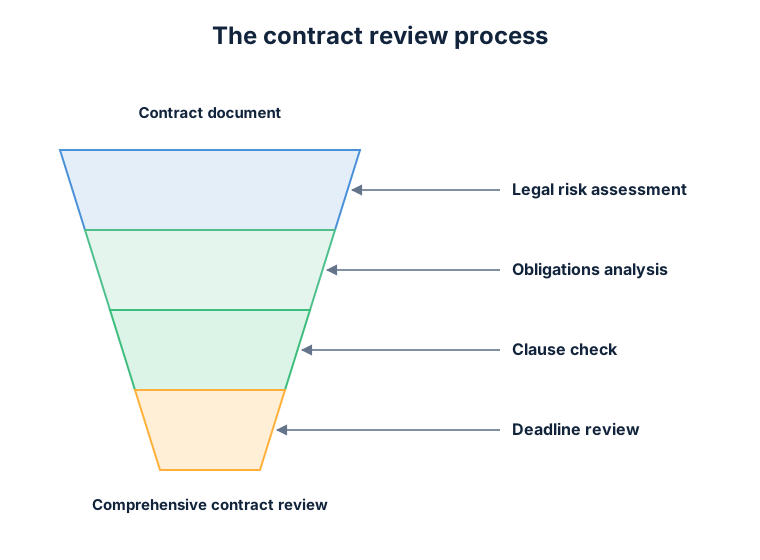
Typical elements of a contract review include:
- Legal risks and pitfalls: are there clauses that breach applicable law or could be invalid? Are there unclear wordings that create room for interpretation and later disputes? (Example: imprecise deadlines or undefined terms.)
- Obligations and liability: what commitments are the parties taking on? Have limitations or exclusions of liability been defined clearly and fairly? A review reveals whether you'd be accepting unreasonably high liability or one-sided obligations.
- Clause check: every contract clause – from notice periods through payment terms to confidentiality – is put under the microscope. Do the clauses align with your interests? Are key provisions missing (e.g. on warranty, penalties or non-compete)?
- Deadlines and dates: the reviewer checks contractual deadlines (e.g. notice periods, delivery times, payment terms) and assesses whether they're realistic and customary. Automatic renewals and option rights are considered too.
A legal review of a contract therefore means far more than a quick skim. There's a rough distinction between a quick read-through and a comprehensive analysis: in a short read-through (e.g. when you just want a one-off check for obvious snags) the lawyer focuses on the biggest sticking points. This often happens within an initial consultation, where notable clauses are discussed verbally. A comprehensive contract review, by contrast, includes a detailed written assessment of all relevant passages, a comparison with current case law and – if you want it – concrete suggested changes. The latter is naturally more involved, but offers maximum protection.
A typical contract review workflow: the contract is handed to the lawyer (in person, by email or via an online platform). They read the document carefully, flag problematic spots and check the content for legality and completeness. You then receive either a review report or a consultation explaining the findings. With online services, communication is often digital: you upload the contract and receive a review report within hours or days. Importantly, a review can address your specific questions – so give the reviewer pointers in advance on the points that matter most to you. That makes the legal review of your contract more targeted and efficient.
The cost of a contract review: the key price factors
What determines the price of a contract review? Costs aren't fixed across the board; they depend on several factors.
| Price factor | Effect on cost |
|---|---|
| Length and complexity | Longer, more complex contracts take more time – and cost more. |
| Contract type | Standard contracts are cheaper than specialised ones. |
| Scope of the review | Basic reviews are cheaper than detailed deep-dives. |
| Lawyer's experience | Experienced specialists charge higher fees. |
| Industry and risk profile | Highly regulated industries require more intensive reviews. |
Here are the key price drivers at a glance:
- Length and complexity of the contract: a two-page simple contract is naturally reviewed faster than a 50-page complex contract with technical annexes. Page count and density directly affect the time required – and therefore the cost.
- Type of contract: the contract type plays a big role. A standardised employment or rental contract can often be reviewed faster than, say, a highly specialised company-purchase agreement. The latter requires careful analysis of numerous provisions (purchase price, warranties, non-compete, guarantees, etc.), which takes more time. Service, licensing and franchise contracts also have their own industry-specific catches.
- Scope of the review: as mentioned above, it makes a difference whether you want only a basic review or a deep-dive. A basic review might check only the most important points, while an intensive review examines and comments on every clause in detail. The deeper the reviewer goes, the higher the price tends to be.
- Experience and specialisation of the lawyer/provider: a specialist with years of experience in contract law or a specific field (e.g. IT contract law) often charges higher rates than a newcomer. In return, the specialist brings valuable expertise and may work more efficiently. Established firms can likewise be pricier than solo practitioners. Lawyer fees for a contract review are charged either as a flat fee or by the hour – and hourly rates of €200–300 are common with experienced commercial lawyers.
- Industry and risk profile: in highly regulated industries (e.g. finance, medicine) or with high-value contracts, review intensity is higher because even small errors can have serious consequences. A review in a simple case (e.g. a private used-car purchase) is therefore easier and cheaper than reviewing a complex B2B supply contract of strategic importance to a company.
Good to know: unlike court proceedings, there are no fixed statutory fees for having a contract reviewed; lawyer fees are freely negotiated. Many firms, however, offer transparent package prices or at least an up-front estimate. In Germany, consumers (private individuals) benefit from one rule in particular: an initial consultation – which can include a simple contract read-through – may by law cost a maximum of €190 plus VAT (around €226 gross) unless otherwise agreed. This cap under §34 of the German Lawyers' Remuneration Act (RVG) keeps one-off consultations affordable. If the scope goes beyond that, or you act as a business, these limits fall away and the fee is freely agreed.
Concrete cost examples: how much does a contract review cost?
Let's get to the key question: how much do you actually have to put on the table to get a contract reviewed? The range is fairly wide, depending on the case. Here are some typical price ranges and real-world examples:
- Simple contract review (short contract, e.g. an employment contract): in many cases the cost is around €150 to €300. Some online providers have established fixed prices of about €200 per contract. For example, one legal-tech service offers a review of any contract type for a flat €219. An initial consultation with a lawyer – as long as it stays a one-off read-through – is also often available for around €150–250. As a private individual, the statutory initial-consultation cap (~€226) may apply here.
- More extensive contract review (complex contract or several documents): for a more complex B2B service contract or, say, a long-term commercial lease, expect higher costs. Prices of roughly €400 to €600 are common for a thorough review, and more depending on scope. For instance, one firm quotes fees from around €550 (incl. VAT) for business contract checks – and it can go higher depending on difficulty and length. A real example: a lengthy architect's contract can easily run around €800 in review fees if the lawyer spends several hours on it.
- Review of terms and conditions (T&Cs): the cost of having T&Cs checked varies widely by scope. For a simple online shop, offers can start at around €300 (net). For extensive T&Cs covering complex services or platforms, €500–1,000 or more can apply. Some services also offer T&C checks at a flat rate. On average, though, budget a few hundred euros to have your T&Cs checked by a specialist lawyer.
- Hourly fees vs. fixed prices: while many modern services advertise fixed prices (e.g. €149, €199 or €299 per contract, depending on length), traditional lawyers often bill by time. A typical hourly rate for contract reviews is €200–250 at commercial law firms. If your contract is very short, that can work out cheaper; but if the review runs to several hours, an hourly fee can end up costing more than a flat price. So our tip: always ask for a cost estimate in advance! Many lawyers will happily give you a range or offer a fixed price once they know the contract's scope. A transparent cost overview protects you from surprises.
Cost overview at a glance: a simple contract review is often available for a few hundred euros. Typical prices sit at around €150–600, depending on the factors above. Individual examples: reviewing an employment contract ~€200, an extensive B2B contract ~€500, a T&C check for an online shop ~€300–400. These benchmarks help with orientation but don't replace a concrete quote in the individual case. Note regional differences too – in big cities, fees can be somewhat higher than in rural areas.
Simple reviews start at around €150; extensive B2B contracts are closer to €500 and up – depending on length, contract type and review depth.
Lawyer vs. digital solutions: a cost comparison
In the age of digitalisation, businesses and individuals face a choice not only of whether to have a contract reviewed but how. Traditionally, you hire a lawyer. But there are now also digital solutions (legal tech) – from automated contract checks to AI-assisted contract analysis. How do they compare on cost?
Traditional review by a lawyer: here you pay for personal expertise. The advantages are obvious: an experienced lawyer can assess the contract in context, advise individually and even negotiate. But quality has its price – lawyer hours are expensive (often €200+ per hour), and complex contracts take several hours of work. You may also need to schedule appointments, which costs time. The main cost drivers with lawyers are the individual effort and specialisation: a top lawyer charges more than a general practitioner. On the plus side: you get a tailored result and, in case of doubt, the lawyer's professional liability insurance backs the work.
Digital solutions and legal tech: in recent years, many tools and services promising automated contract review have emerged. They range from simple online contract checks (where you upload the contract and get a standard analysis) to AI-based contract analysis systems for enterprises. The biggest advantage of digital solutions is usually speed and scalability. AI can scan a contract in minutes and flag notable clauses – work that would take a human hours. Costs also tend to be lower: automated checks are often offered as a fixed price per contract or on subscription. For example, a legal-tech platform offers contract reviews from around €149 net, including a phone debrief with a lawyer. For businesses, there are AI tools from a few hundred euros per month, depending on scope. Enterprise solutions with extensive features can run to several thousand euros a month. Small firms sometimes benefit from free basic versions or cheap entry packages – albeit with limited functionality.
A sample cost comparison (10-page contract): suppose you have a 10-page draft. Option A: lawyer – a lawyer might budget around 2–3 hours, costing roughly €400–750 depending on the hourly rate. In return you get individual advice. Option B: digital check – an online service reviews the contract automatically within minutes and a lawyer takes a look, at a fixed price of, say, €219. The result arrives faster and cheaper, though usually as a standardised written report without deeper follow-up (some services do allow questions within the price). Option C: AI software in-house – if you have many contracts, your own software may pay off. For a few hundred euros a month, AI can speed up contract review by 50–80%. Per contract, the unit cost can be very low – though you must factor in software licence costs and setup.
Weighing pros and cons: the digital contract review is an efficiency booster – especially for standardised contracts (e.g. recurring NDAs, supplier contracts), AI can save a lot of time. You get fast results and pay less per document. But technology doesn't replace legal judgement: AI spots unusual clauses, but a human ultimately has to assess them. That's why reputable legal-tech services often combine the two: the software analyses, a lawyer does the final check. With the traditional lawyer you get everything from one source, individually and with a consultation – but at a higher cost. For important, complex contracts (acquisitions, complicated licensing deals, etc.) you'll still bring in the lawyer you trust. For simpler standard contracts or high volumes, however, digital solutions can save a lot of money without sacrificing quality. Studies even show that AI can match junior lawyers on common contracts – only faster and cheaper.
The future is hybrid: first the software reviews the contract, then the lawyer smooths out the final rough edges – human + machine, not either-or.
Is a contract review worth it? Cost-benefit analysis
Given the cost, some ask: is the effort even worth it? Should you really spend money reviewing every agreement?
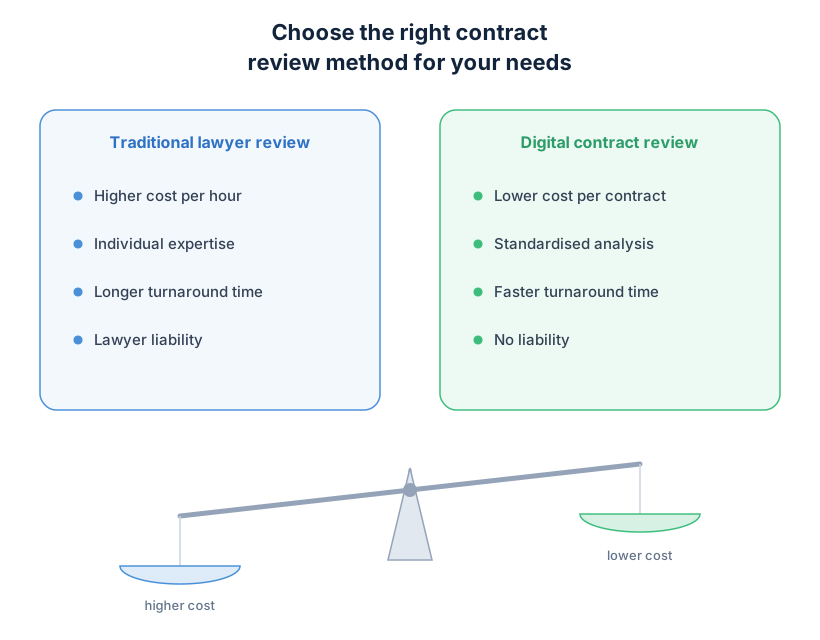
The cost-benefit calculation is positive in many cases – especially for important contracts. Here are a few considerations on the value of a contract review:
- Avoiding financial risks: a few hundred euros for a review can save thousands in downstream costs. Example: a contract hides a penalty or liability assumption that could ruin you in the worst case. If the lawyer spots that clause in time, you can negotiate it or adjust the contract – potentially saving a great deal of money. Without a review you might have signed blind and faced nasty surprises later. The investment in a review is a kind of insurance against incalculable risks.
- Protection from unfavourable clauses: contracts are often drafted by the stronger party (e.g. the employer, landlord or client), who naturally words the text in their favour. A comprehensive review uncovers one-sided or unfair clauses, e.g. overlong notice periods, automatic renewals, a warranty exclusion or hidden fees. You get pointers on what's disadvantageous and can have it improved.
- Greater negotiating confidence: someone who knows their contract inside out – including every contingency – walks into the negotiation or signing very differently. Reviews provide certainty: you know exactly what you're signing, can field questions confidently and justify suggested changes if needed. In business especially, that builds trust with partners. Saying "I'll have my lawyer check the contract first" signals professionalism, and many counterparties become more willing to accommodate change requests.
- ROI examples: the return on investment of a contract review is often impressive. Imagine a lawyer spots a clause in a software licence agreement that saddles you with unlimited liability for indirect damages – six-figure sums in the worst case. A small change (introducing a liability cap) prevents that worst-case scenario. Cost of the review: maybe €500. Saving in the event of a claim: potentially €100,000+. Such cases show that a review pays off whenever the contract matters to you and could get expensive in a dispute. The cost is usually small relative to the risk it covers.
Of course, you don't need to review every trivial contract. For very small sums or completely standardised everyday transactions (e.g. buying office supplies), having everything signed off by a lawyer would be overkill. But as soon as the contract is important or long-term, or you don't fully understand it, you should invest in a review. Businesses that sign contracts regularly know it: legal prevention is cheaper than later litigation. The cost-benefit calculation comes out positive when you consider that a court dispute quickly racks up far higher costs (court fees, lawyer fees, possible damages) than a preventive review.
A review costing around €500 can surface a liability clause that would otherwise run into six figures in a claim. Measured against the risk it covers, the review fee is usually negligible.
Tips: how to cut the cost of a contract review
Even though a contract review matters, nobody wants to pay more than necessary.
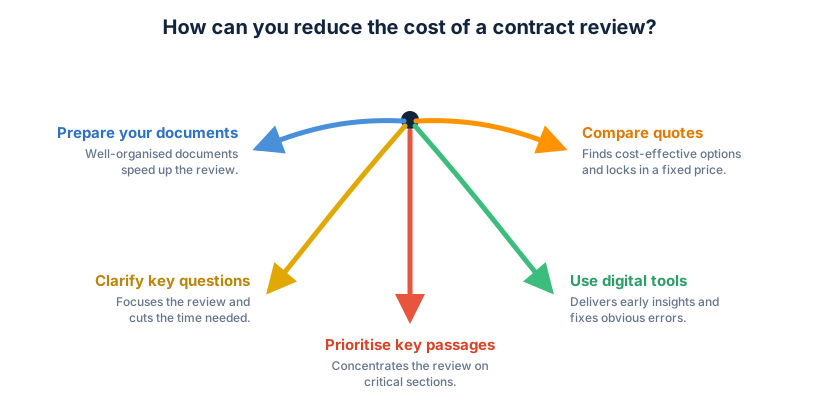
Fortunately, there are some practical tips for making a contract review efficient and therefore cheaper:
- Prepare your documents well: hand the lawyer or review service all relevant contract documents, neatly organised. That includes any annexes, terms and conditions or previous amendments. If the lawyer first has to request missing documents or hunt for cross-references, that wastes time (and time is money!). A clear PDF or a complete contract folder speeds up the review.
- Clarify key questions in advance: think about which points worry you. Are there specific clauses you don't understand, or risks you suspect? Share these concrete questions up front. Then the reviewer can focus on them rather than explaining everything "into the blue". The more focused the review, the less effort it takes.
- Prioritise important passages: not every clause is equally critical. Tell the lawyer which parts are business-critical for you – e.g. pricing and payment terms, termination rules, liability. Those can be reviewed especially intensively, while less significant sections need less time. Such prioritisation can save review time while still covering the key risks.
- Use digital tools for a pre-check: before you go to the lawyer, you can gain initial insights yourself. Use legal-tech tools for a quick pre-check, for instance. Some online platforms offer free or cheap checks that scan a contract for certain standard problems. Even if that's no substitute for a professional, you get a feel for the contract – and can steer the subsequent legal advice more precisely.
- Compare offers and agree a fixed price: can you get a contract review cheaply? Yes – by comparing providers, for example. Get two quotes from firms if needed, or check whether a fixed price is possible. Many lawyers agree to a flat fee, especially when the contract isn't too extensive. A fixed price gives planning certainty and gives the lawyer an incentive to work efficiently. But mind the quality: the cheapest price is no use if the reviewer is sloppy. So look at experience and reviews, not just the money.
In addition, companies can consider booking regular reviews as a package (see the next section). And not least: legal expenses insurance sometimes covers advice or lawyer fees, at least in part. Check your cover – you may already be entitled to a free initial consultation you can use for the contract review.
Contract review for companies: what does a regular review cost?
For companies – small or large – reviewing contracts is part of daily business. Whether it's the framework agreement with a supplier, recurring employment contracts or complex project contracts: the question here is one of a cost-efficient routine. What does it cost when a company has contracts reviewed regularly, and how can that be budgeted?
Retainers and flat-fee arrangements: many firms work with external lawyers or firms on an ongoing mandate. That means agreeing, say, a monthly flat fee or an hour-contingent contract (retainer). In return the lawyer is on hand to review a set number of contracts per month or provide a certain amount of advice time. The cost of such models depends on the expected workload. A small startup may get by with a package of 5 hours of advice a month, while a larger company needs a more extensive arrangement. The advantage: the unit cost per contract often drops when you book a package, and you have a reliable partnership.
In-house counsel vs. outsourcing: larger companies above a certain size employ their own in-house lawyers or legal departments that review contracts internally. This creates staff costs rather than case-by-case costs. In many cases, an in-house lawyer only pays off above a certain contract volume or complexity. Smaller companies tend to outsource the review, because a full-time lawyer of their own would be more expensive than a few external reviews. It's a trade-off: at what number of contracts per year is it cheaper to hire someone permanently, or at least have them on call?
Effort in complex B2B contracts: in B2B especially, companies often sign extensive contracts affecting several departments (engineering, legal, procurement, sales). Reviewing them sometimes requires interdisciplinary coordination – e.g. the lawyer has to understand technical annexes or clarify with sales which clauses are negotiable. That naturally increases the effort and therefore the cost. So companies should budget accordingly for major contracts. Sometimes project flat fees are agreed for such cases: e.g. reviewing an entire contract framework (including side agreements) for a fixed sum. That can cost several thousand euros, but it's necessary when, say, a company acquisition or joint-venture contract is at stake and nothing can go wrong.
Savings through standardisation and software: a key lever for companies that manage many contracts is standardisation. Use your own contract templates wherever possible and run them past lawyers in advance. If 90% of the clauses are always the same, each new review only has to focus on the deviations – which saves enormous time. Contract Lifecycle Management (CLM) systems come into play here too. Such software helps manage and also review contracts. Modern CLM tools often have built-in AI review modules that automatically analyse contracts as they enter the system and compare them with your standard clauses. This speeds up many routine reviews or even handles them automatically. Introducing such software costs money up front, but in the medium to long term companies can save plenty in lawyer fees, because only exceptional cases still need external review. Clear processes (e.g. checklists for contract conclusions, staff training) also prevent the most common errors in advance.
Ready for the next step?
Book a demo with our team and see top.legal in action