
Nine benefits of electronic signatures in the sales process: faster contract closing, lower costs, and greater legal certainty under eIDAS — used across the sales cycle, not just at signing.
The sales department has the important task of selling a company's product and thus generating income. Yet many contracts fail at the end of a sales cycle. In most cases, this is due to the contract conclusion phase.
After long and exhausting sales talks and negotiations with the customer, the contract is concluded. But in many cases, this is not immediately signed and the deal fails.
This is because it can take forever to send documents to other teams in different departments. There, they are lost in the data towers until they are sent back to the other party. In extreme cases, it can take months until all necessary signatures are received from both contractual partners. In some cases, several months can elapse simply because a signature is missing.
The solution is known as something that everyone seems to have heard of. Yet not many professionals choose to use them: electronic signatures.
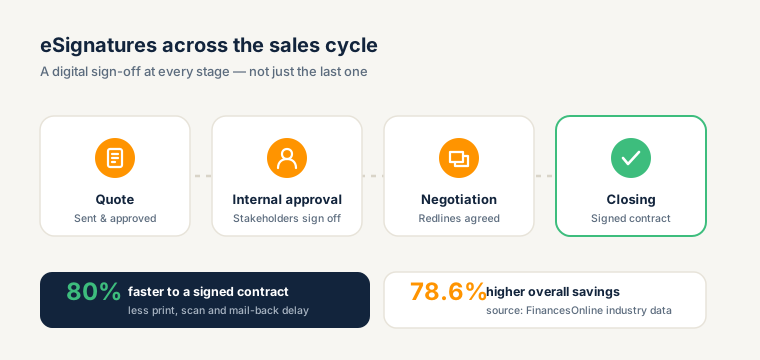
An eSignature tool can speed up the final signing of a contract, but even before that last phase, sales teams should use eSignatures throughout their sales process. Below, we cover the most important benefits of using eSignatures across the sales cycle.
Tip: Want to close deals faster? top.legal's electronic signature replaces printing and scanning with a digital close inside your contract workflow. New to the topic? Start with our guide to electronic signatures.
The 9 benefits of electronic signatures in sales
Electronic signatures speed up contract closing by up to 80%, cut printing and mailing costs, and raise security through audit trails. They enable mobile signing, are legally valid under eIDAS, and integrate directly into CRM and CLM workflows — which is why they pay off across the whole sales cycle, not just at the final signature.
1. Reducing paperwork
Once your company has introduced an eSignature, it is no longer necessary to print out every document or contract that needs to be signed by an authorized person. The document can simply be signed online and sent by email to the other party to do the same. As a result, the lack of the need for written signatures alone reduces all the effort and work on printing and paper work that was previously indispensable.
2. Reduce wasteful paper spending
This may be an obvious advantage, but it should not be underestimated. A large company processes hundreds of contracts every day. It may be hard to imagine that all these documents would have to be printed on paper to be signed and sent to the contracting party.
Even though spending on paper may appear relatively low compared to other costs within the company, the money saved is money saved and therefore a higher return.
3. Speeding up the sales process
Not to forget the fact that many signatures are required and are made throughout the sales cycle. In reality, a document is not just signed in the last step, but many signatures are required before the actual contract is signed.
It is an unnecessary waste of time to obtain every signature from the appropriate persons. This is an expense that could be avoided. Time and nerves could therefore be put to better use. The offers and suggestions must be authorized and sent back and forth, and therefore integrating an eSignature into this process can increase the total number of completed sales, as everyone Sale is completed faster, which frees up extra time for the next customer.
4. Efficient workflow spread across different regions
Today, organizations are spread all over the world. Support for electronic signatures can promote collaboration within the organization and departments can also involve employees from different countries.
eSignatures supports the creation of departments with different professionals regardless of their country of residence. This is due to the ability to send online documents in just a few seconds, sign them just as quickly and send them back. This eliminates the need to print out, manually sign, scan, upload and then send by email.
5. Fewer headaches due to inefficient approval phases
Sales documents usually require the approval of various stakeholders: stakeholders, managers, and employees.
The sales document can only be completed when these approvals have been received in the appropriate order. It is obvious that this period of time can delay important decisions or investments and that it takes longer to implement organizational decisions and achieve the planned goals.
After the constant back-and-forth of emails and messages, decisions are lost in the long process of paper and formalities, which can lead to a general decline in motivation within teams.
6. Improving customer and employee satisfaction
By integrating digital solutions with the aim of simplifying sales processes, much of the frustration and annoyance of collecting and waiting for the right signatures can be removed. Employees in particular benefit from this, but also indirectly, of course, customers.
The faster and better their orders are processed, the more likely they will retain a positive experience and thus the opinion of the company's sales team and be more willing to deepen their business relationship and recommend cooperation to other business partners.
7. Enabling better management
The introduction of eSignature availability also leads to a general better contract management system. Writing, organizing, reviewing, and modifying a large number of different contract documents can be considered a discipline in itself.
eSignatures reduce the risk of tedious updates and duplicate versions of the same document due to minor differences.
8. Improved collaboration between departments
By using eSignature at an early stage of the sales cycle and not just for the last step, it is possible to improve communication and thus collaboration between departments.
Each department can now be sure that the document they're working on has been pre-approved and doesn't have to wait to verify an unsigned email. This applies not only to the department, but to every participant in the cycle.
9. Greater legal certainty
An advanced electronic signature creates greater legal certainty than a simple electronic signature or documents exchanged by email: the signatory is unambiguously linked to the signature, and any subsequent change to the signed document can be detected. Especially in sales, where quotes and contracts have to be concluded with legal certainty, this is a decisive advantage over a scanned wet-ink signature.
Are there any disadvantages to the electronic signature?
Yes — three limitations to keep in mind: contracts subject to a statutory written-form requirement (for example some employment or consumer-credit contracts) may need a qualified electronic signature (QES) to be valid; contracts outside the EU follow different standards than eIDAS; and your counterparty has to accept e-signing in the first place.
A proper and secure eSignature implementation does not come for free. Companies usually need a contract management solution that supports secure electronic signatures — selecting one and integrating it into existing business processes takes some effort. Weighing those costs against the considerable benefits, however, it is hard to argue against using electronic signatures across the contract lifecycle. According to DocuSign, eliminating the costs of printing, sending and storing agreements saves companies an average of around $36 per agreement.
Frequently asked questions
What are the benefits of using digital signatures in sales processes?
Digital signatures shorten the time between "yes" and a signed contract, so deals close faster and revenue is recognised sooner. Across the sales cycle they also cut printing and mailing costs, remove the print-sign-scan loop for remote and cross-border teams, speed up internal approvals, and give reps a real-time view of where a document sits. Used with an advanced or qualified electronic signature, they also add legal certainty that a scanned wet-ink signature cannot.
Are electronic signatures legally valid for sales contracts?
In the EU, electronic signatures are legally valid under the eIDAS regulation, and most B2B sales contracts can be closed with a simple or advanced electronic signature. Contracts with a statutory written-form requirement may need a qualified electronic signature (QES). See our guide on signature compliance for the details.
Where in the sales process should you introduce e-signatures?
Not just at the final signature. Quotes, order forms, and internal approvals all involve sign-offs earlier in the cycle, so introducing e-signatures across the whole process — rather than only for the closing document — is where most of the time savings come from. For a side-by-side look at the gains, see eSignature vs. traditional signature.
Ready for the next step?
Book a demo with our team and see top.legal in action