
Offer, acceptance, consideration, capacity, legality and form: learn the six requirements that make a contract legally valid and enforceable — and the moment a contract is actually formed.
A contract can look like a simple thing: two parties agree on something, sign, and the matter is settled. But what actually makes an agreement legally binding? Which requirements have to be met for a contract to be more than a friendly handshake?
Whether it is a sales contract, an employment contract or a software licence, the legal foundations are always the same. Without an offer, acceptance and a clear consideration, an arrangement often remains nothing more than a non-binding promise. And it is not only about formalities: anyone who understands the fundamental terms of a contract can enter into agreements more safely and avoid the pitfalls that lead to disputes — or even to the contract being void. This article explains what a contract is made of and which six requirements make it valid.
How Is a Contract Defined?
A contract is a legally binding agreement between two or more parties that sets out the terms of a particular transaction or relationship. It serves two core functions:
- It defines the rights and obligations of the parties involved.
- It creates a clear, shared understanding of what each party will provide or receive.
Contracts are used in a wide range of situations — selling goods and services, employment relationships, leases and tenancies, or licensing arrangements.
The key point: not every arrangement is automatically an enforceable contract. An agreement may be treated as unenforceable if it contains unlawful provisions, offends public policy, or was not properly formed in the first place.
Why Are the Terms of a Contract Important?
The main purpose of a contract's terms is to define both parties' expectations clearly. In a well-drafted contract, it is spelled out exactly what each party has to do, when it has to do it, and what it receives in return. This is how you avoid the misunderstandings and miscommunication that would otherwise lead to conflict and legal action.
Contracts govern expectations. Without clear terms, one side may assume a payment is due only after six months, while the other expects it within four weeks. Discrepancies like this disappear when the contract records exactly who has to do what, and by when. The clearer the wording, the lower the risk that a business relationship turns into a lawsuit.
A contract also protects against sudden changes of course, not just misunderstandings. Anyone who has watched a business partner walk back their commitments mid-project knows how valuable a binding agreement is. A cleanly drafted contract creates a foundation you can rely on — regardless of whether market conditions shift or a party changes its mind overnight.
What the contract says also matters in court. Unclear or defective clauses can leave claims unenforceable, and anyone relying on verbal assurances is usually the one who loses out. In more complex agreements especially, it pays to work out the terms so that they hold up in a dispute. Terms can be agreed either expressly or by implication — and the difference between the two is decisive for enforceability.
Express terms of a contract
Clauses that are set out explicitly in the contract are known as express terms. They are usually documented in writing and often contain the most important and most detailed elements of the agreement.
Typical examples of express terms include:
- Delivery dates
- Payment terms
- Warranties and guarantees
- Limitations or exclusions of liability
Express terms are the most binding and clearest part of a contract and form the basis of the agreement. In the event of a disagreement, they are the first thing relied on, and the parties have to abide by them.
Implied terms of a contract
Implied terms are those that are not expressly stated but are nonetheless treated as part of the contract. They typically arise from recognised industry standards or general legal rules, and serve to supplement the express clauses by filling gaps. For example, in a contract for the sale of goods it is implied that the items delivered must be of satisfactory quality.
It is important to understand, though, that implied terms are less certain and specific than express ones. Because they are not written out in the contract, their exact meaning and scope are harder to pin down — which can lead to questions of interpretation and problems with enforcement in a dispute. The more you regulate expressly, the less is left to interpretation.
The 6 Fundamental Elements of Any Contract
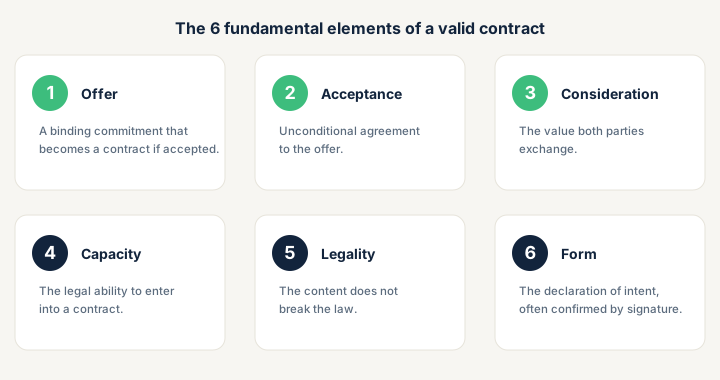
Regardless of its length — whether 10 pages or 100 — a contract must contain six fundamental elements to count as a legally binding agreement. These six components are also the requirements for a contract to be validly formed in the first place.
1. Offer
A contract begins with an offer. An offer is a binding statement made by one party in the knowledge that it will become a contract as soon as the other party accepts the terms. It is, in effect, the invitation to enter into a binding agreement.
The party making the offer is the offeror; the party receiving it is the offeree. In contract law it can be difficult to determine whether an offer has actually been made: mere advertising or a non-binding price quote is not yet an offer. It must be concrete enough that the recipient is entitled to treat it as a legally binding offer.
2. Acceptance
Acceptance is the unconditional agreement to the terms of an offer. To be valid, it must be made in the manner specified by the offeror. Depending on the type of contract, acceptance may be given orally, in writing, or through conduct.
In many cases acceptance is shown by an action: paying at the till in a shop accepts the offer, and so does "confirming" an order in an online store. If the acceptance differs from the offer, it counts in law as a new offer (a counter-offer). That is why it matters to know what a valid acceptance looks like.
3. Consideration
The third element is consideration — the value each party receives from the contract. It is usually thought of as a payment, but consideration can also take other forms:
- The exchange of goods
- The provision of services
- The transfer of property
- A promise to do, or to refrain from doing, a particular thing
What matters is that each side gives something and receives something. A one-sided promise without consideration generally does not create an enforceable contract.
4. Capacity
For a contract to be enforceable, each party must be legally able to enter into it and to perform the resulting obligations. Whether a party has capacity depends mainly on three factors:
- Age
- Mental competence
- Legal status
For this reason, each party's capacity should be checked before the contract is signed — for example, by verifying age and legal status. That ensures the parties can meet the terms of the agreement and fulfil their obligations. In cases of doubt, it is advisable to seek legal advice.
5. Legality
Legality means that the content and purpose of a contract comply with the applicable laws and regulations. This element is central: if a clause is found to be unlawful, it can render the entire contract void, so that a court will not enforce it.
As a rule, a contractual clause is lawful if it is clear and unambiguous and breaches neither the law nor public policy. Agreements are treated as impermissible where they, for example:
- Involve illegal goods or services
- Are designed to commit fraud or deception
- Unlawfully restrain free competition
6. Declaration of Intent and Form
By signing, a party expresses its intention to be bound by the terms of the contract. In legal terms, the signature serves as evidence of that intent and makes the agreement provable in court if a dispute arises.
For a contract to be valid, each party must express its agreement — often by signing. A signature can take various forms: a handwritten signature, an electronic signature, or, depending on the context, an initial or a stamp. What matters is that it is clearly recognisable that the party agrees to the terms. Many contracts are valid without any particular form; for certain transactions, however — such as property purchases — the law prescribes a specific form.
These six elements determine whether a contract is formed and whether it is enforceable. Ensuring all of them are present lays the foundation for a legally binding agreement with clear, enforceable rights and obligations. For how to translate these foundations into concrete, well-drafted clauses, see our guide to contract terms.
Frequently Asked Questions About the Fundamental Terms of a Contract
What requirements must a contract meet to be valid?
A contract is valid when six elements are present: an offer, its acceptance, consideration, the capacity of both parties, lawful content, and — where the law requires it — the correct form. If any of these elements is missing, the contract is likely to be void or unenforceable.
At what point is a contract formed?
A contract is formed the moment one party makes an offer and the other party accepts it unconditionally. Both declarations — offer and acceptance — must match in substance. A signature is not always necessary for this, but it makes the formation of the contract provable.
Is a verbal contract legally valid?
Yes. Most contracts require no particular form and are therefore legally valid even when made verbally, provided offer, acceptance and consideration are present. In practice, however, a verbal contract is hard to prove. For certain transactions — such as property purchases or guarantees — the law also prescribes written form or notarisation.
What is the difference between express and implied terms?
Express terms are written out and appear directly in the contract; implied terms arise from the law, industry standards or the nature of the transaction without being stated. Express terms are clearer and easier to enforce — so regulate as much as possible expressly.
What happens if a fundamental element is missing?
If a core element is missing, the contract is usually void or voidable. Without consideration there is no binding obligation; where a party lacks capacity the contract can be challenged; and unlawful content renders the affected clause, or the whole contract, void.
Ready for the next step?
Book a demo with our team and see top.legal in action