
Spot the signs of a broken contract process — bottlenecks, lost versions, missed deadlines — and the five fixes that make contracting faster and lower-risk.
Every deal a company closes runs on contracts, and every contract follows a process — from the first draft to the day it expires. Yet most companies still run that process manually, out of email inboxes and shared drives, without ever treating it as something that can be measured and improved.
The result is a contract process that quietly leaks time, money, and goodwill. This article shows you how to recognise the signs of a broken contract process, why those weak points cost more than they look, and the practical steps that make contracting faster and less risky.
Signs your contract process is flawed
If you work with contracts at any level, you already know how frustrating a bad process feels for everyone involved. These are the weak points that show up again and again.
Drafting accurate terms takes too long
The legal team has to make sure every clause is complete and correct. At the same time, contracts have to move fast so they don't hold up the business. That tension between speed and accuracy is hard to manage — and when there are no templates or reusable clauses to lean on, every contract starts from zero.
Legal is treated as a bottleneck
Missing templates, unclear approval routes, and manual hand-offs slow the legal team down. When every contract has to queue for legal review, legal gets blamed for the delay — and the people trying to close a deal get frustrated. Left unfixed, this recurring friction forces a company to choose between moving quickly and getting the wording right.
Versions and edits get lost
At every stage there should be exactly one agreed version of the contract. Instead, copies get scattered across email threads and desktops in a well-meaning attempt to save time. A single edited version quickly gets lost in the noise, and no one is sure which draft is current.
Deadlines and renewals slip by
With dozens or hundreds of live contracts, key dates are easy to miss. Without automatic reminders, there's no reliable way to track renewals, obligations, and expiry dates — which leads to auto-renewals no one wanted and opportunities left on the table.
Signing runs on paper and email
Printing a contract, posting it for signature, and waiting for it to come back is slow. Emailing it so the other side can print, sign, scan, and return it is barely faster. In most deals, getting the signature takes longer than agreeing the terms did.
Why a broken contract process is so expensive
According to a WorldCC study, the average Fortune 1000 company has around 40,000 active contracts on any given day. Every one of those has to be drafted, reviewed, negotiated, and approved — and that's before a single one is managed through its lifetime.
At that scale, small inefficiencies compound fast. This is why contract management matters: it treats the whole life cycle of a contractual relationship as a business process — one that can be measured, analysed, and improved. Done well, contract management does far more than shield a company from legal risk; it makes the entire contract process run faster and the business run more profitably. The flip side is just as real: poor contract management quietly drains resources — we break the hidden costs down in our guide to inefficiency in contract management.
Where a contract process breaks down
A contract process is a series of stages — request, drafting, negotiation, approval, signature, storage, compliance, review, and renewal — and a weak process tends to break at the hand-offs between them. Rather than repeat every phase here, see our breakdown of the key stages of contract management for the full life cycle, and our contract creation process guide for the drafting-to-signature steps in detail.
The point isn't the number of stages. It's that a flawed process loses information at each transition — the request is vague, the draft ignores it, the negotiated terms never make it into the signed version, and the renewal date is never tracked. Fixing the process means closing those gaps.
How to fix a broken contract process
Improving how you handle contracts pays off at every level of the company. These are the steps that make the biggest difference.
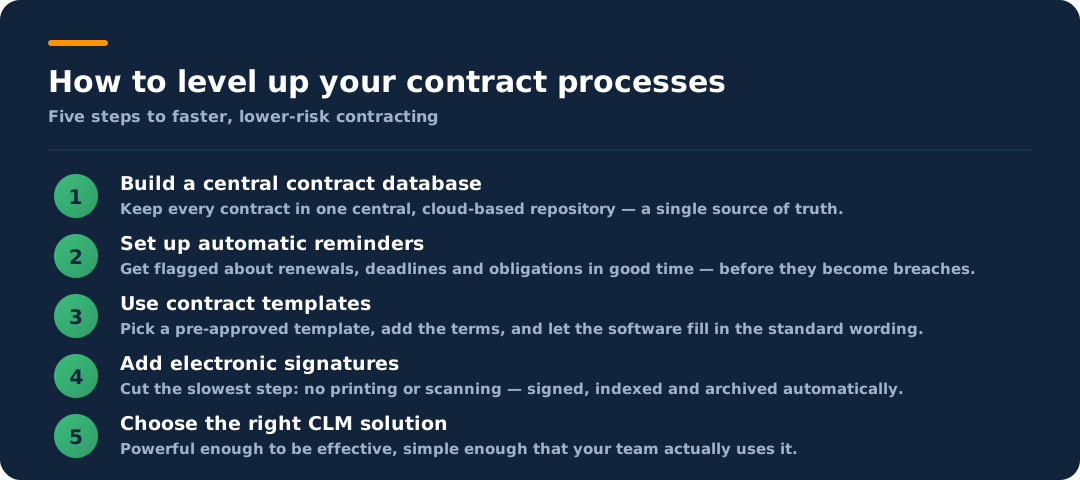
Build a central contract database
Secure, searchable storage is the foundation. A central, cloud-based contract repository means teams across departments work from the same source instead of hunting for documents. Used well, a repository becomes a single source of truth — one place where every contract is classified, labelled, and tagged with the metadata you need to find it later.
Set up automatic reminders
You and your team need to stay ahead of critical dates — renewals, obligations, and expiry deadlines. Good contract management software does this for you, flagging upcoming renewals in good time and warning you about approaching obligations before they turn into breaches.
Use contract templates
Drafting from scratch every time is slow and error-prone. A library of pre-approved contract templates and clauses fixes that: pick the contract type, add the specific terms, and let the software fill in the standard language and party details. Standardising the wording reduces typos and legal inconsistencies — which directly reduces risk.
Add electronic signatures
Manual signing is often the slowest step in the whole process. Electronic signatures cut that time dramatically: no printing, no scanning, no posting. They typically index and archive the signed contract automatically, save the cost of handling paper, and are more secure, since they make tampering far harder to hide.
Choose the right contract management solution
Your software should be powerful enough to be effective and simple enough that your team actually uses it. Many tools are expensive, hard to set up, and still don't cover what you need — which only adds friction to the life cycle. That's why it pays to do your homework and choose the best contract management solution for your business before you commit.
Ready for the next step?
Book a demo with our team and see top.legal in action