
Contract Lifecycle Management (CLM) explained: the 7 phases, best practices, must-have software features, ROI and 2026 trends. A definitive guide for legal, procurement and finance teams.
Are missed deadlines, approval bottlenecks and contract clutter slowing your company down? When managing contracts feels like a never-ending challenge, it's time to rethink your approach.
Contracts touch every part of a business — closing deals, managing vendors, hiring employees. But keeping track of them is where things get complicated. Missed renewals, confusing revisions and compliance risks turn contract management into a frustrating, time-consuming process. Contract Lifecycle Management (CLM) is the structured answer: a software-supported method that keeps every contract in one system from initiation to termination. This guide walks through what CLM is, the seven phases it covers, the best practices that make it work, and how to choose the right software.
What is Contract Lifecycle Management?
Contract Lifecycle Management (CLM) is the end-to-end process of managing contracts across seven phases — initiation, authoring, negotiation, approval, storage, monitoring and renewal. CLM software automates these phases, centralizes contract data, and reduces legal and financial risk.
Contract Lifecycle Management is more than a software category — it's a methodology that treats the contract process as one connected lifecycle. Unlike e-signature tools, which cover only the moment of signing, or document management systems, which only structure storage, CLM spans every step: from the first template selection to the archiving audit after a contract ends.
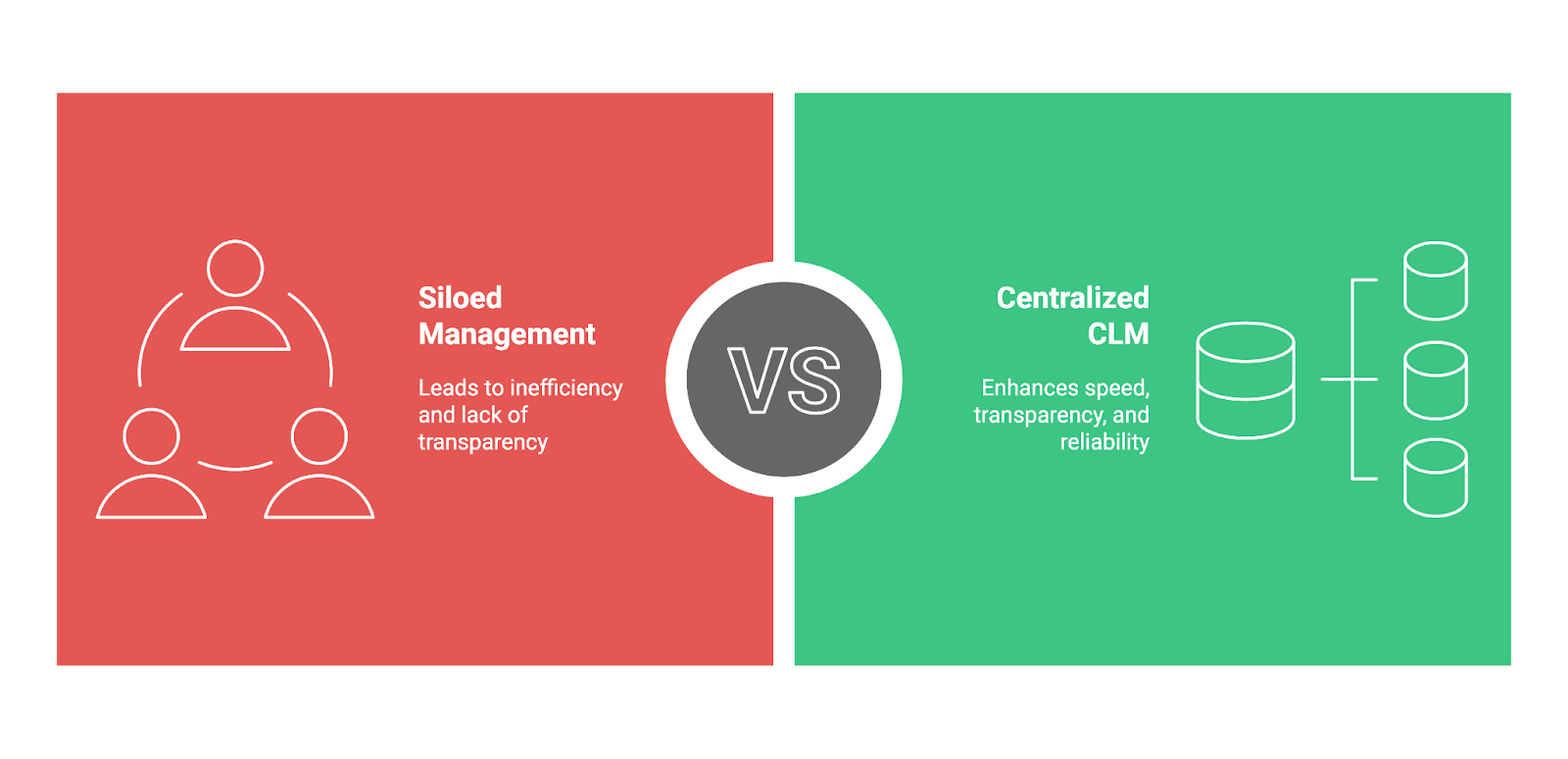
Instead of handling contracts in silos — where different teams use separate systems and manual processes — CLM centralizes everything in one place, making contract management faster, more transparent and more reliable.
How CLM differs from traditional contract management
Traditional contract management is fragmented and reactive. Documents live in email attachments, shared drives or physical files; approvals happen over email; and tracking obligations requires manual effort. CLM replaces these outdated methods with a centralized, automated system built on standardized templates, AI-powered contract analysis, automated approval workflows, and real-time monitoring of milestones, compliance and performance.
What are the seven phases of the contract lifecycle?
The contract lifecycle has seven phases: initiation, authoring, negotiation, approval, storage, monitoring and renewal or termination. CLM software supports each phase with specific features, from template libraries to audit-ready archiving.
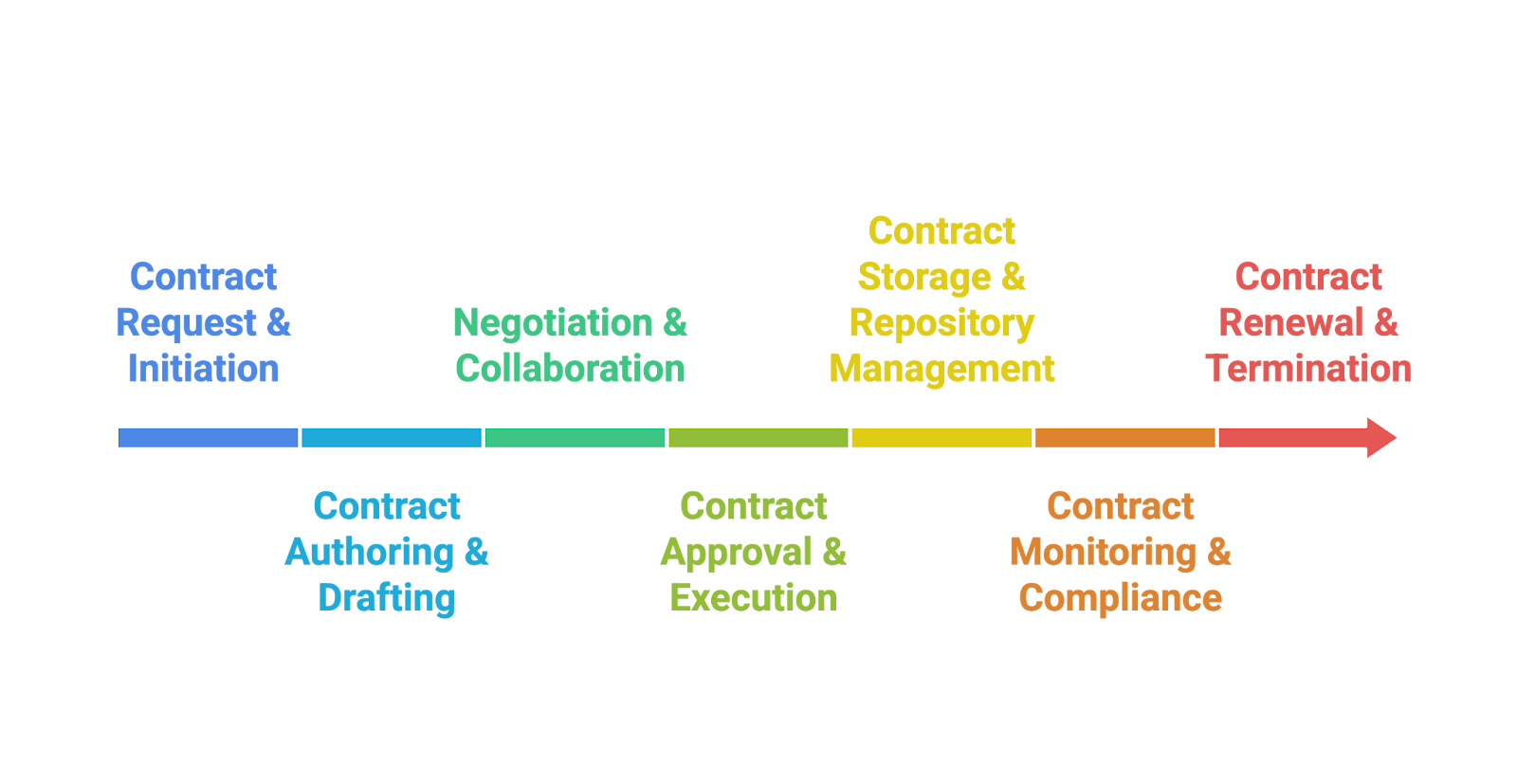
| Phase | What happens | Common risks | CLM software function |
|---|---|---|---|
| Initiation | Template selection, needs assessment, scope definition | Wrong template, missing clauses, undefined scope | Template library, clause standards, workflow triggers |
| Authoring | Drafting from pre-approved templates and clause libraries | Inconsistent language, drafting errors, slow legal review | AI-assisted drafting, clause library, version control |
| Negotiation | Clause changes with the counterparty, redline exchange | Version chaos, lost redline history, email-attachment drama | Markup editor, versioning, external collaboration |
| Approval & execution | Internal sign-offs, compliance check, signature | Bottlenecks, missing audit trail, wrong signature level | Approval workflows, escalation rules, integrated e-signature |
| Storage & repository | Secure, searchable archiving of signed contracts | Lost documents, no access control, poor searchability | Central repository, role-based access, metadata tagging |
| Monitoring & compliance | Deadline tracking, SLA compliance, obligation management | Missed renewal notices, no SLA reminders, knowledge lost when staff leave | Automated reminders, dashboards, owner-independent trackers |
| Renewal & termination | Renewal decision, terms review, orderly close-out | Unwanted auto-renewals, missed renegotiation, data loss | Renewal workflows, pre-renewal checklist, audit-ready archiving |
The monitoring phase is the weakest point in most organizations. Deadline information lives in individual Outlook calendars or spreadsheets and gets lost when employees leave or ownership changes hands. A CLM system solves exactly this through central deadline management and owner-independent reminders.
How does CLM differ from e-signature and document management?
CLM covers the entire contract lifecycle. E-signature covers only the signing phase; document management covers only storage. CLM platforms integrate e-signature as a module but are structurally broader, built for negotiation, compliance and deadline tracking.
This distinction causes recurring confusion in procurement conversations. Using DocuSign doesn't mean you have a CLM — you have a signature tool. Using SharePoint doesn't mean you have a CLM — you have a file store. Only a platform that coordinates all seven phases is a true CLM. E-signature vendors sell CLM modules as paid add-ons but are signature-first at their core; native CLM platforms like top.legal, Icertis or Ironclad are structured the other way around, with signing as one module inside a broader architecture.
What features must CLM software offer in 2026?
CLM software in 2026 offers at least eight core features: a template library, a markup editor, approval workflows, integrated e-signature, automated deadline tracking, an audit trail, CRM integration, and AI-powered contract analysis.
These eight functions form the baseline this year:
- Template library with clause standards and variable fields
- Markup editor for internal and external clause negotiation
- Approval workflows with escalation and four-eyes logic
- Integrated e-signature across the appropriate signature levels
- Automated deadline tracking with owner-independent reminders
- Audit trail with gap-free, compliance-ready logging
- CRM integration with HubSpot, Salesforce, Pipedrive and others
- AI-powered contract analysis for clause review and risk detection
What's new in 2026 is the AI governance component: teams using AI-assisted clause review increasingly have to show how the underlying AI models are governed. The emerging standard is ISO/IEC 42001, the AI management system certification. See our detailed breakdown of CLM requirements and compliance in CLM software for the full checklist.
Best practices for implementing contract lifecycle management
The best practices for CLM implementation are: assess your current process first, define measurable objectives, choose software that integrates with your existing stack, standardize templates and train users, then continuously monitor and optimize.
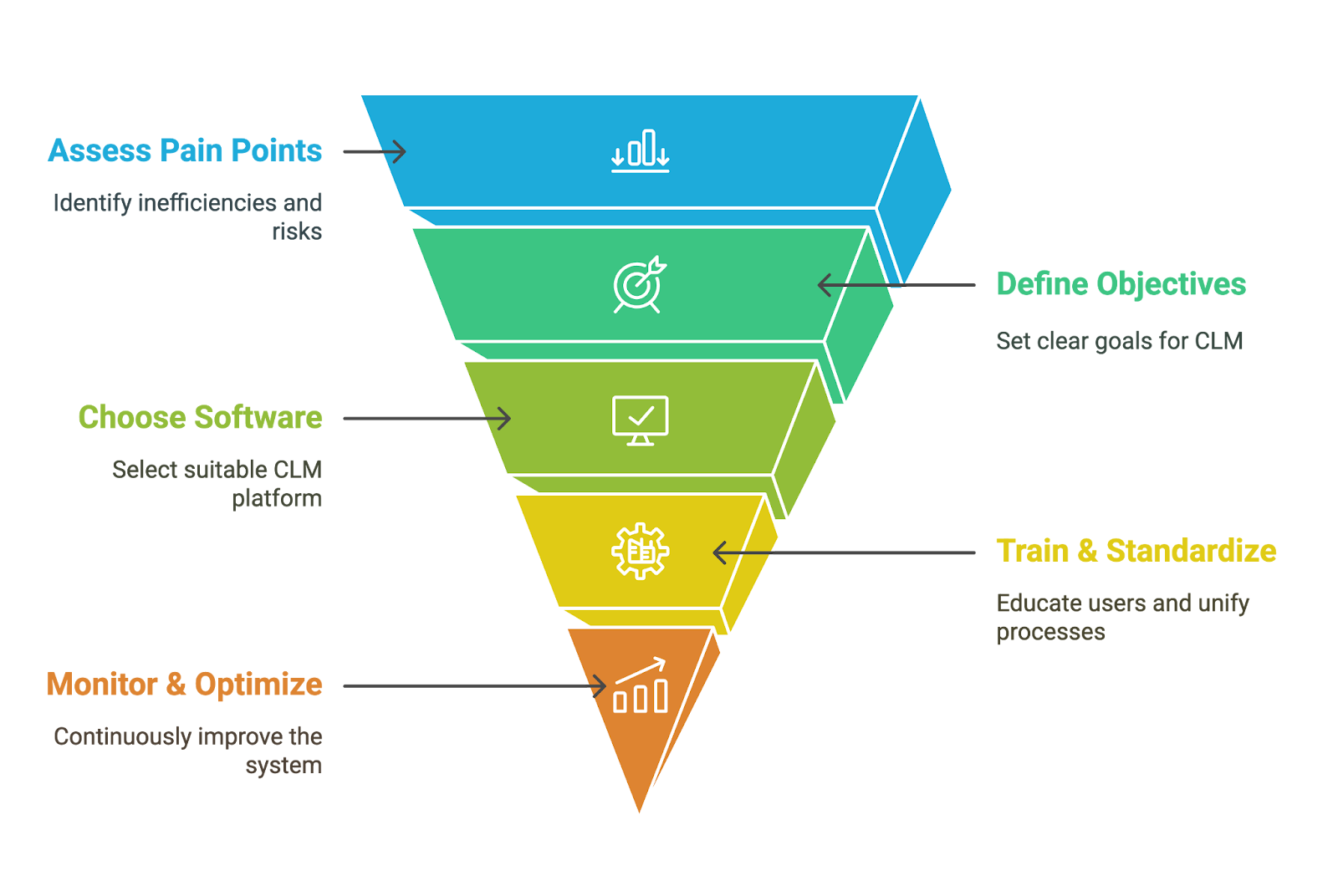
Adopting CLM is as much a process change as a software purchase. These five best practices separate successful rollouts from shelfware:
- Assess your current contract process. Map where contracts actually live and where they break down. Legal teams may struggle with slow reviews, procurement may lack visibility into supplier contracts, sales may face approval delays, and finance may find invoices hard to audit. Understanding these inefficiencies defines the improvements you actually need.
- Define measurable objectives. Decide what success looks like — faster approvals, fewer missed renewals, better audit readiness — so the rollout aligns with business priorities rather than vague "digitalization".
- Choose software that fits your stack. Prioritize automated workflows, AI-powered analysis and seamless integration with the tools you already run (Salesforce, SharePoint, Google Drive, ERP). A well-integrated system enhances efficiency instead of creating another silo.
- Standardize templates and train users. A CLM is only as effective as the teams using it. Establish standardized templates and playbooks, and train stakeholders to navigate the platform and use its features.
- Monitor, optimize and improve. Implementation doesn't end at go-live. Review performance, gather user feedback, and analyze contract data to keep refining workflows and automation settings.
What ROI does CLM software deliver?
Vendor studies report that CLM software cuts contract cycle times by roughly 50% and sharply reduces missed deadlines. Industry analysts such as Gartner and Forrester cite typical payback periods of 6 to 18 months, depending on contract volume and complexity.
A word of caution: concrete ROI figures vary widely by industry, contract volume and implementation depth, and vendor-published statistics should be read critically. For a 100-person mid-market company with around 500 active contracts, typical CLM costs run €30,000–80,000 per year (license plus onboarding). The return comes from three sources: saved legal-counsel time, avoided penalties from missed deadlines, and faster deal closure.
Who needs CLM software, and when does it pay off?
CLM software pays off once you have roughly 50+ active contracts or 20+ people who touch contracts. Mid-market companies with 50–500 employees are the typical fit; large enterprises use heavyweight platforms, while mid-market teams favor providers with strong localization and integration.
The rule of thumb: as soon as a spreadsheet no longer works as a contract register, CLM pays off. The pattern is consistent — teams maintain a spreadsheet with contract type, contact, department and term, review it manually, until the list becomes unmanageable and deadlines slip through. That's the signal a CLM is overdue. The need is sharpest in multi-entity structures, where finding and searching contracts across legally separate subsidiaries becomes unmanageable without role-based access and per-entity separation.
Best CLM software solutions in 2026
The right CLM solution fits your industry, company size and integration needs. A strong platform should offer AI-powered contract analysis, automated workflows, smart drafting tools with clause libraries, a centralized searchable repository, and seamless CRM/ERP integration.
top.legal
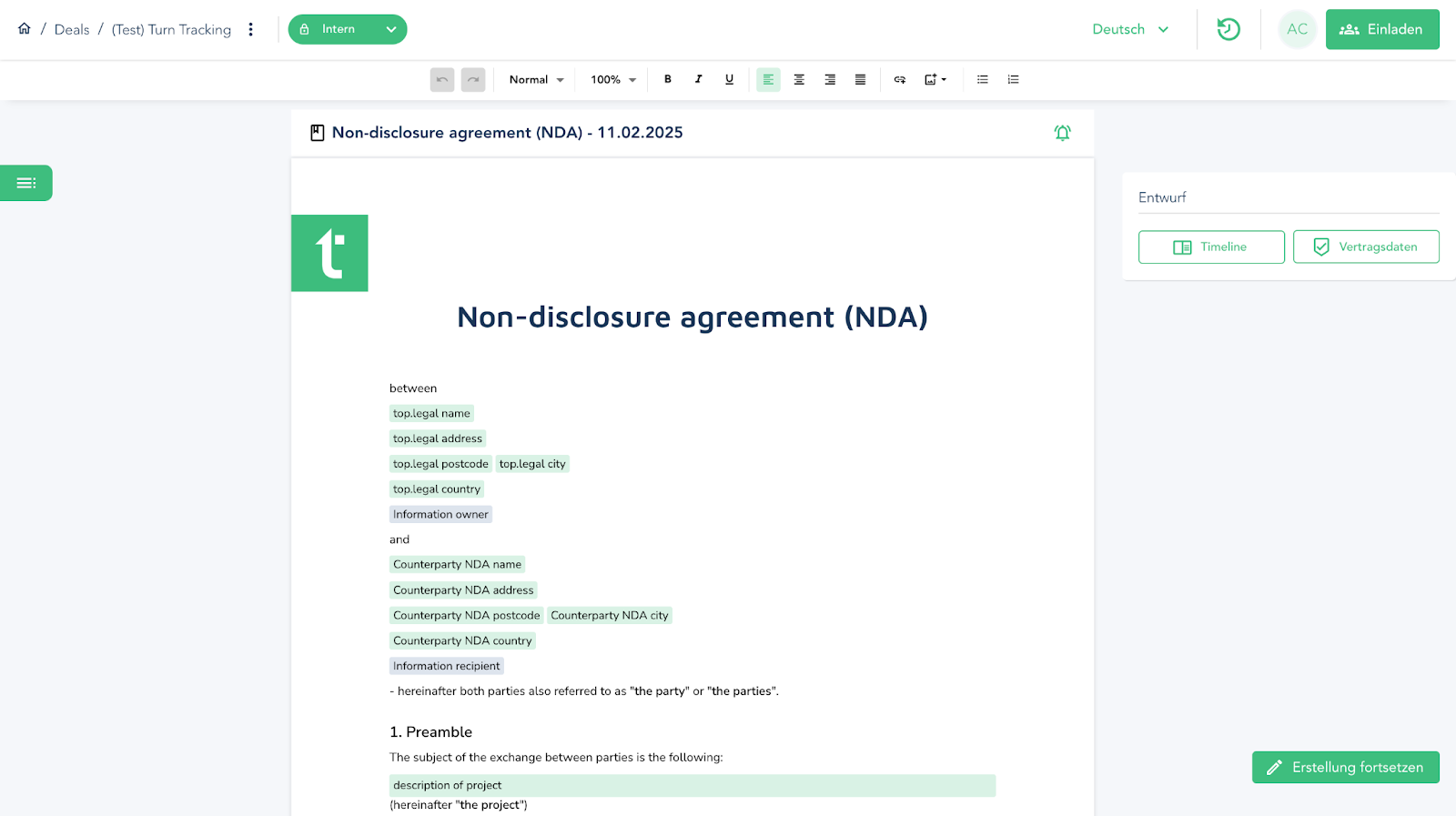
Best for AI-powered contract negotiation and easy collaboration. top.legal simplifies contract management with AI automation, real-time collaboration and built-in e-signatures. Instead of endless email exchanges, all parties review, suggest edits and approve changes directly on the platform, with clear tracking of who needs to act next. Automated workflows keep approvals moving while AI surfaces key terms and deadlines.
Icertis
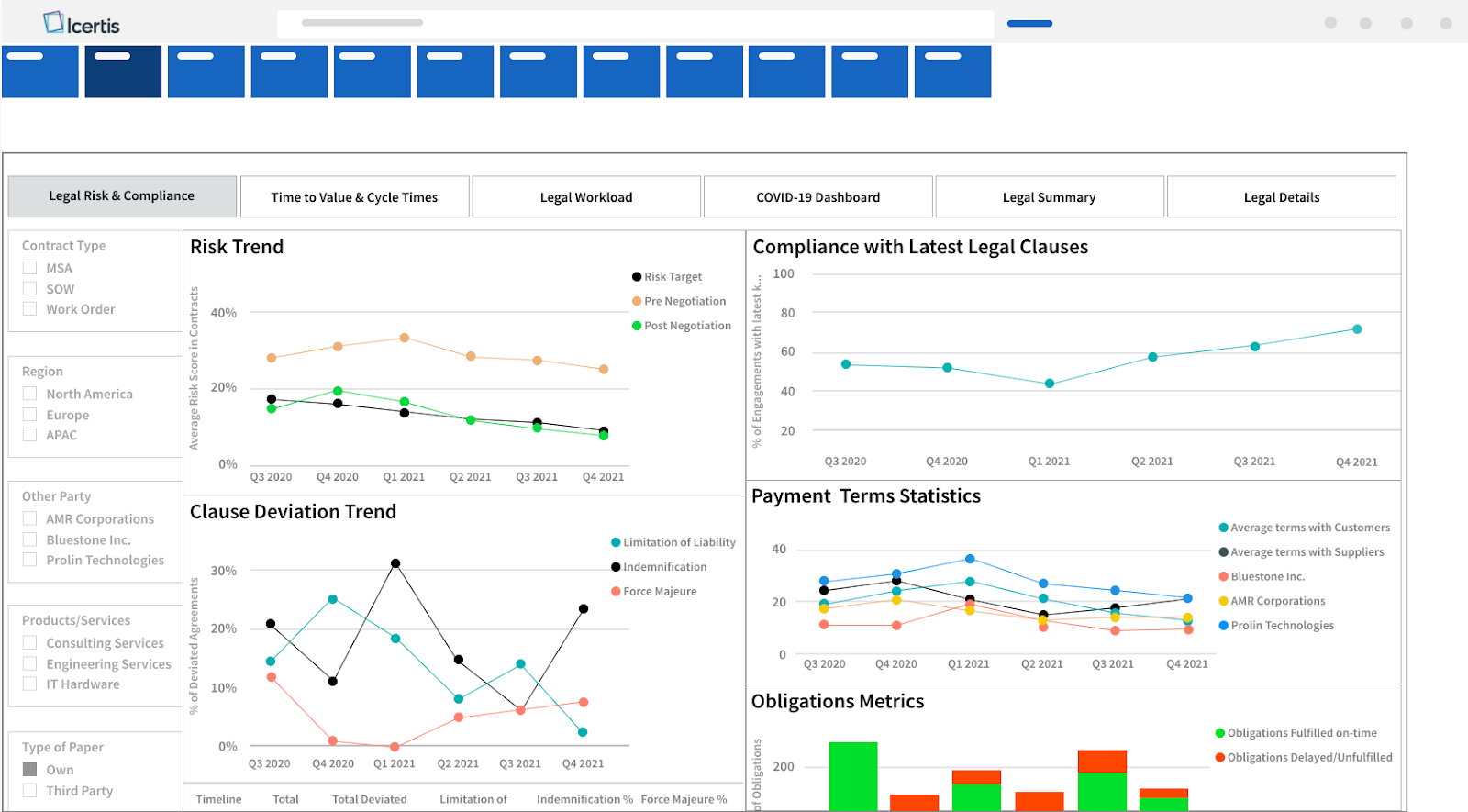
Best for compliance and regulatory contract management. Icertis is a top choice for highly regulated industries that need strict compliance and risk management, with AI-driven insights, automated compliance tracking and robust reporting that keep contracts aligned with regulatory requirements.
Outlaw
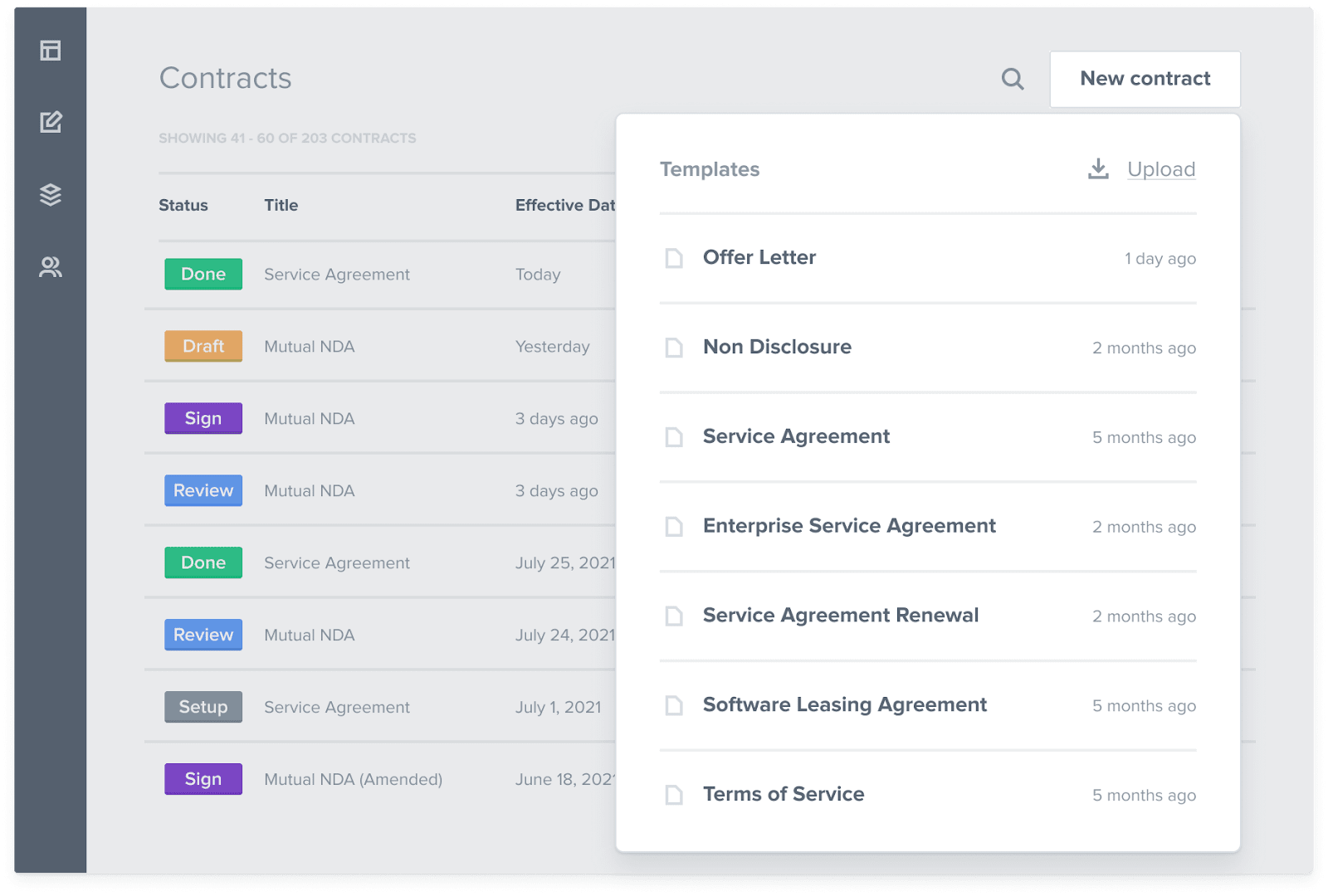
Best for simple, intuitive contract management. Outlaw offers a clean interface and dynamic templates that make drafting easy without legal expertise, plus built-in redlining, real-time collaboration and e-signature for smooth negotiations and faster approvals.
ContractSafe
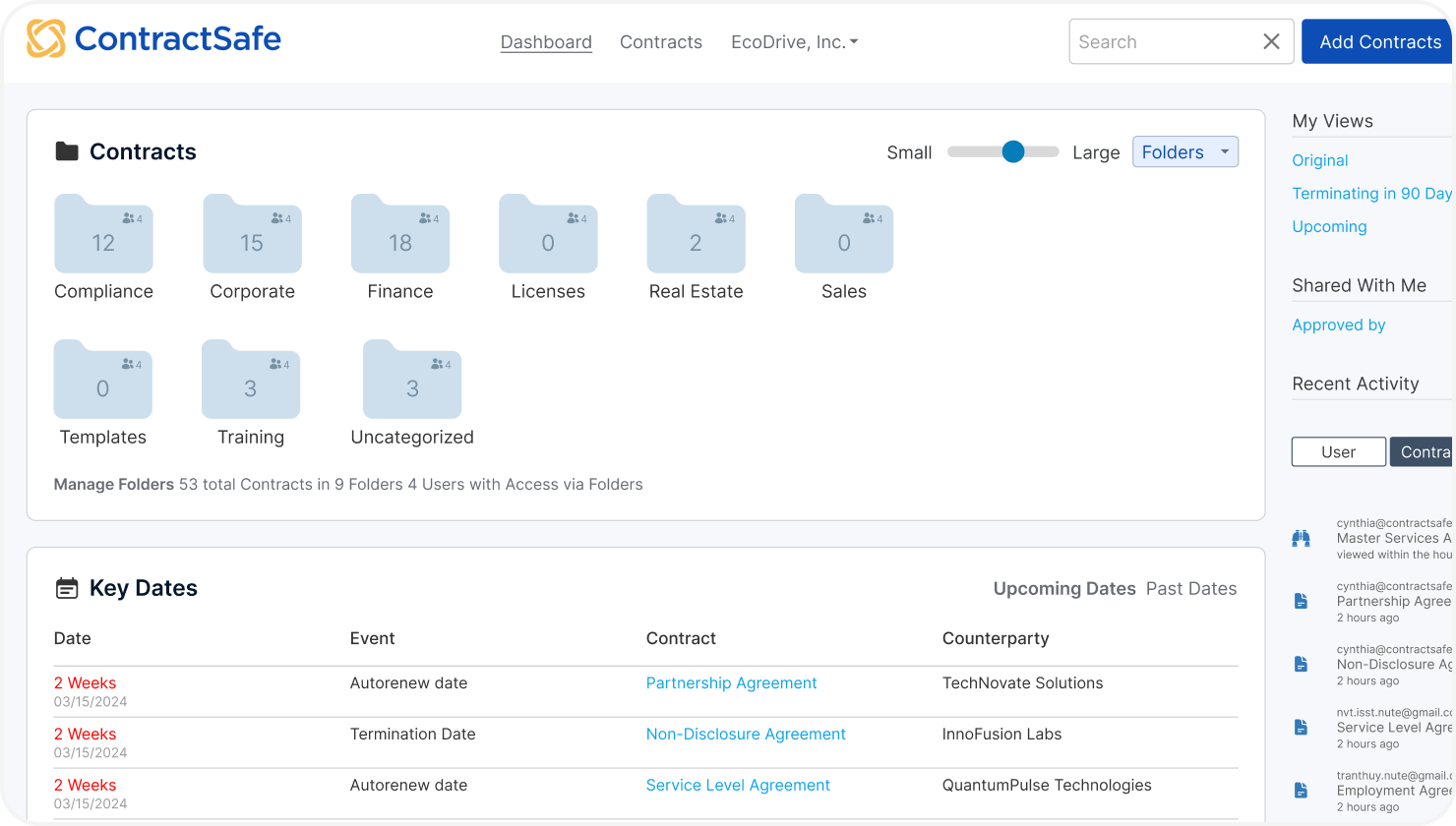
Best for simple, secure contract storage and tracking. ContractSafe focuses on secure document storage, fast retrieval and automated deadline tracking, with advanced search, tagging, role-based access and key-date alerts — without the complexity of full enterprise CLM.
SpotDraft
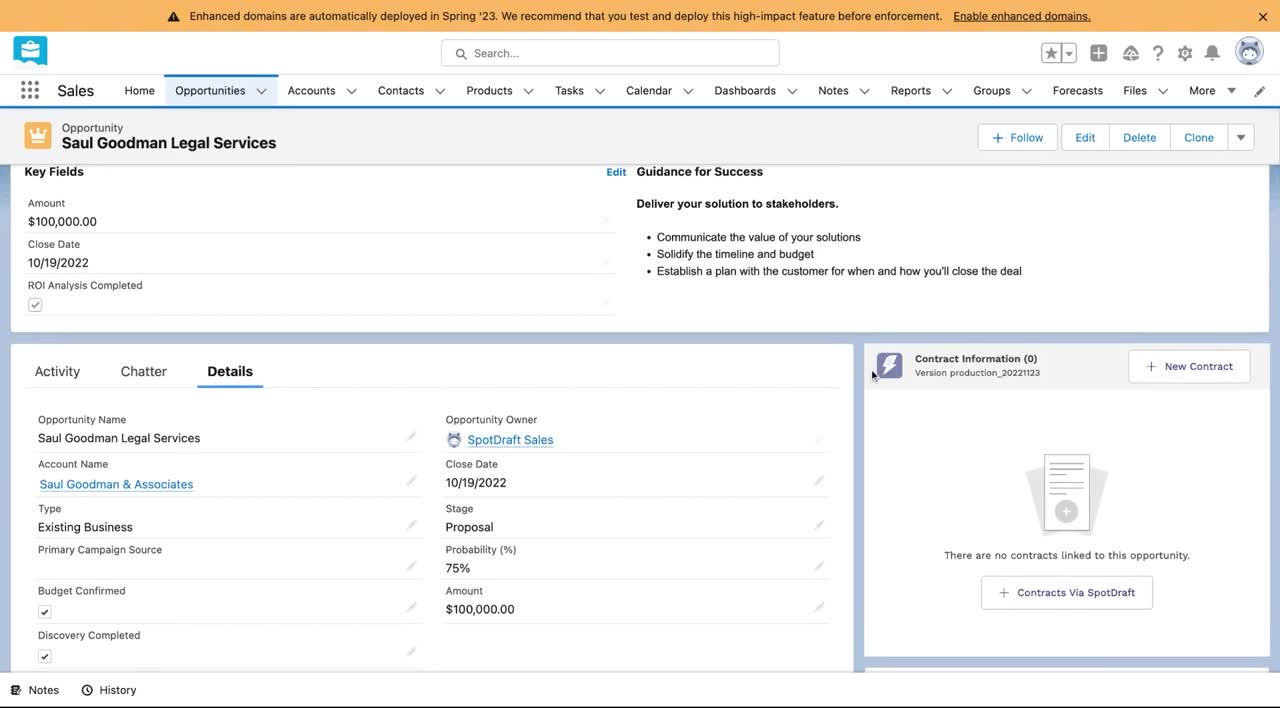
Best for AI-powered contract automation. SpotDraft streamlines drafting, review and execution with AI-driven automation, an intelligent repository, automated approval and compliance tracking, plus built-in analytics and integrations.
For a deeper feature comparison, see our guide to contract management software and integrating CLM software with your existing tools.
FAQ about Contract Lifecycle Management
What does CLM software cost for a 50-person team? Mid-market license costs typically range from around €290 per month for standard per-user models up to €2,000 per month for tier-based models, plus one-time onboarding of €5,000–20,000.
Which phase of the contract lifecycle is most often neglected? The monitoring phase. Deadlines, SLA compliance and renewal decisions are still managed in Outlook calendars or spreadsheets in many organizations, and get lost when staff change.
Do I need CLM software for every contract? No. One-off contracts with no negotiation or deadline tracking don't need CLM. The need arises once you regularly negotiate contracts with counterparties or must track deadlines across many parallel agreements.
How is CLM different from procurement software? Procurement software (Coupa, Jaggaer) focuses on sourcing, supplier management and purchasing. CLM focuses on negotiation, clause management and the contract lifecycle. They overlap on procurement contracts but are structurally different.
Is CLM software data-protection compliant? Reputable CLM vendors are GDPR-compliant and provide a data-processing agreement. For US vendors without EU hosting, standard contractual clauses plus a transfer-impact assessment apply. See compliance in CLM software for the full picture.
Turning contracts into a strategic advantage
Contracts should drive business success, not create bottlenecks. CLM minimizes risk, improves collaboration and maximizes value — but only when the process change lands alongside the software. Assess where your process breaks today, choose a platform that fits your stack, and start with the monitoring phase, where most teams lose the most value.
To see a real contract workflow end to end, book a free top.legal demo.
Sources
- Gartner Magic Quadrant for Contract Lifecycle Management
- Forrester Wave: Contract Lifecycle Management
- Salesforce CLM Definition Guide
- Icertis Knowledge Base, Contract Lifecycle Management
- top.legal discovery-call insights (anonymized)
Ready for the next step?
Book a demo with our team and see top.legal in action