
A lawsuit can be extremely costly as it involves legal and court fees before, during, and even after the actual process.
Litigation is expensive — whether or not you win. Legal and court fees pile up before, during and even after a case, and a mid-sized commercial dispute can quickly run into five figures. This article breaks down what makes up litigation costs, the hourly rates enterprises should expect, and how to cap that risk long before you reach a courtroom.
What is the average cost of a lawsuit for companies?
Litigation can be extremely costly, as it involves legal and court fees before, during and even after the actual process. Apart from pro bono work, lawyers are not free — in Germany or anywhere else — at least not in civil and commercial matters.
To conduct a lawsuit, the parties must hire lawyers who typically charge an hourly fee, with rates ranging between 200 and 700 EUR. These vary by law firm, the number of lawyers involved, the complexity of the matter and other factors. On top of legal fees come court fees, and the amount in dispute also drives how expensive a case becomes.
All in all, a lawsuit easily costs thousands of euros, which is why avoiding it should be every company's goal. A clear understanding of the economics of litigation helps you do exactly that: once you know the cost drivers, you can settle disputes earlier and more cheaply — or head them off entirely.
What is the difference between attorney fees and court costs?
Although the two terms sound similar and are often used interchangeably, there is a real difference between attorney fees and court costs. Knowing it matters, because it clarifies the overall cost of a lawsuit.
Court costs: These cover filing, hearings, conciliation and the other services the court provides during proceedings. They are collected by the competent court. Under certain circumstances — usually a proven lack of financial resources, and depending on the jurisdiction — a party may apply to be exempted from paying them. Court costs are not harmonised at European Union level; they are set by national legislation and therefore vary from one Member State to another.
Attorney fees: To litigate, the parties must hire a lawyer who charges a fee, unless the lawyer takes the case on pro bono. Fees are generally calculated on an hourly basis, and the hourly rate depends on the seniority of the lawyer handling the case: experienced lawyers charge more than those at the start of their careers. The total therefore depends on how many hours the legal team spends on the case.
On top of fees, lawyers usually incur certain costs on behalf of their clients — the so-called disbursements. Attorney fees and disbursements together make up the legal costs. As a rule, the losing party ends up bearing the other side's costs, but this is decided case by case: the court has discretion to determine what percentage each party pays and how much the prevailing party can recover.
What is included in litigation costs?
Even though every lawsuit is different, the costs generally cover preparatory activities, investigation and research, negotiations with the other party, the actual litigation and any appeal. So the total depends mainly on how many of these stages a dispute has to pass through before it is resolved. Most disputes go through the following stages:
Preparatory activities: One party makes a claim against the other, usually in writing — whether it concerns a breach of contract, damage caused or an unfulfilled obligation. The plaintiff's lawyer contacts the defendant and asks them to correct the conduct complained of. Depending on how the other party reacts, this can end the matter or lead to the next phase.
Investigation and research: The lawyers investigate the dispute thoroughly — its causes, the facts, the legal basis and the applicable law. They gather the necessary evidence (case law, witnesses, documents) and develop the legal strategy best suited to their client. This is usually the most expensive phase, because research and strategy are time-consuming, which means more billable hours and higher fees.
Negotiation with the other party: The lawyers on both sides try to reach a solution that benefits their respective clients. If the dispute cannot be resolved out of court, the only option left is to go to trial.
Litigation: A claim is filed with a judicial authority. In it, the parties set out what they claim from the other side and what they demand. Once the defendant receives the claim, they must respond. The evidentiary phase follows, in which both sides present their evidence, and finally the court decides who prevails.
Appeal: After the ruling, the losing party — now the appellant — has the right to ask a higher court (the appellate court) to review the decision. The appellate court examines the case files and the evidence and decides whether the lower court's ruling was correct. Filing an appeal does not automatically overturn the original decision unless the request is granted.
Average hourly rates
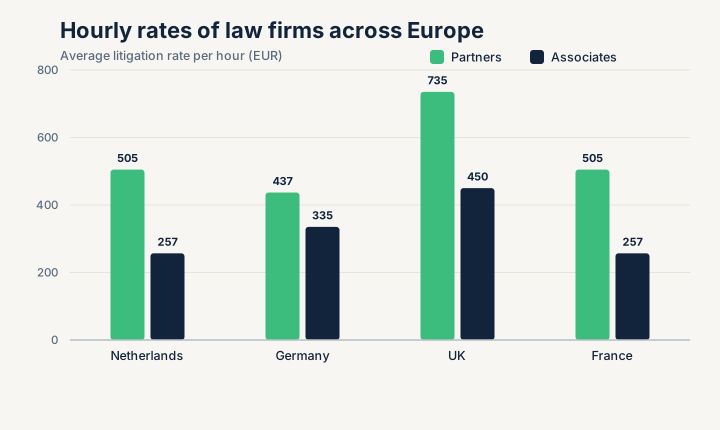
Average hourly rates vary significantly by country. The United Kingdom tops the ranking at around 700 euros per partner hour for litigation, while in continental Europe it drops to up to 600 euros. In Germany, a litigation partner charges an average of 400 euros per hour — 300 euros less than their UK counterparts. The gap between German and British associates is smaller: the difference in their hourly rates is around 120 euros. These are general benchmarks; the actual cost depends heavily on the firm's profile and the complexity of the matter.
What can lead to litigation?
For a company, knowing the main causes of litigation is fundamental to avoiding lawsuits. Even though the risk depends heavily on a company's activities, the most common triggers are the following:
Contract breaches: Contracts are the most important tool companies have to define business relationships between partners, contractors, vendors and customers, setting out each party's rights and obligations. Even carefully drafted contracts cannot always prevent disputes, because non-compliance often cannot be foreseen at the drafting stage. Poorly drafted contracts, however, sharply increase the likelihood of a lawsuit — and the attorney and court costs that come with it. Consistent contract enforcement reduces that risk.
Disputes between shareholders: Shareholders may disagree on how the company should be run, misuse company funds or breach their fiduciary duties. All of these situations can lead to litigation. Well-drafted, clear shareholder agreements and articles of association help defuse these sources of conflict.
Confidentiality: Legal action is often taken against a party bound to secrecy to stop confidential or sensitive information from reaching third parties. Contracts that clearly define the scope of confidentiality obligations protect the company and prevent future disputes.
Conclusion
Litigation costs are made up of court costs and attorney fees, and they grow with every stage a dispute passes through. The most effective lever therefore isn't in the courtroom but in the contract: clear drafting, well-defined obligations and consistent follow-through on your agreements reduce the odds of ever ending up in a costly lawsuit.
Ready for the next step?
Book a demo with our team and see top.legal in action