
What a circular resolution (resolution by circulation) is, when it is valid, how the process works, and practical examples for boards, companies and associations.
Have you ever had to make an important decision without calling a formal meeting? Organizations often need to approve something quickly, and waiting for the next scheduled meeting is not always practical. This is where a circular resolution comes in.
Instead of gathering everyone in a room, physically or virtually, the decision is put in writing and passed around for approval. It saves time, keeps approvals moving, and avoids the delay of finding a date that suits everyone.
This article explains what a circular resolution is, when it is legally valid, how the process runs step by step, and where it fits. You will also find worked examples for companies, boards, associations, and homeowners' groups.
Definition & Legal Basis
What Is a Circular Resolution?
A circular resolution is a formal decision taken by the members or directors of a legal entity — a company, a board, an association, or a homeowners' community — without holding a meeting. The resolution is circulated to everyone entitled to vote, and they record their approval in writing. Once the required approvals are in, the decision is binding.
The same thing goes by several names, and they mean essentially the same mechanism:
- Resolution by circulation — the phrasing used in the Indian Companies Act and in much Commonwealth practice
- Written resolution — the usual term in UK company law
- Circulating resolution — common in Australian practice
- Circular board resolution — used when it is the board rather than the shareholders deciding
- Umlaufbeschluss — the German equivalent
Legal Framework
Whether a circular resolution is available, and on what terms, depends on the jurisdiction and the type of entity. Most company law systems permit them, but the conditions differ.
India:
- Section 175 of the Companies Act 2013 governs the passing of board resolutions by circulation. The draft resolution must be circulated to all directors, together with the necessary supporting papers.
- It passes when approved by a majority of the directors entitled to vote on it.
- There is an important limit: if at least one-third of the directors require the matter to be decided at a meeting, the chairperson must put it to a board meeting instead.
- Certain matters are reserved by law for a properly convened board meeting and cannot be dealt with by circulation at all.
United Kingdom:
- Private limited companies (Ltd): The Companies Act permits written resolutions of the members, subject to the relevant voting threshold — an ordinary resolution needs a simple majority of eligible votes, a special resolution needs 75%.
- Public limited companies (PLC): The written resolution procedure is not available to public companies, so key shareholder decisions require a meeting.
Other Commonwealth jurisdictions:
- Singapore, Malaysia, and Australia all recognise written or circulating resolutions for private companies and, in most cases, for boards. The precise requirements sit partly in the companies legislation and partly in the entity's own constitution, so check both.
Germany:
- GmbH: Permitted under the GmbH Act, but all shareholders must consent either to the decision itself or to the written voting procedure.
- AG: The supervisory board may resolve in writing unless a member objects.
- Associations and homeowners' communities: Written resolutions are available, generally requiring the agreement of all members.
United States:
- Many states allow boards to act by unanimous written consent, provided every director signs.
The recurring theme across jurisdictions: check the entity's own constitution or articles alongside the statute. The articles frequently tighten the statutory default, and occasionally exclude circulation entirely for particular decisions.
How It Differs from a Resolution Passed at a Meeting
A resolution passed at a meeting allows discussion before the vote. A circular resolution does not. That means:
- No live discussion or debate
- A higher approval threshold in many systems, sometimes unanimity
- The whole decision documented in writing from the outset
When Is a Circular Resolution Valid?
To bind the entity, a circular resolution has to meet certain conditions. They exist to keep the process transparent and the outcome enforceable.
General conditions for validity
-
Everyone entitled to vote must receive it. Every shareholder, director, or member with voting rights needs a copy, along with the supporting papers. Skipping someone is the most common ground for challenging the result later.
-
The wording must be unambiguous. Set out exactly what is being decided, why, and in what context. Vague drafting is what turns into a dispute.
-
Votes must be properly documented. Approval has to be explicit and recorded — a signature, a recognised electronic signature, or another legally accepted form of written consent. This record is your proof that the decision was validly taken.
-
The right threshold must be met. This is the detail people get wrong most often, because it varies: a majority of directors entitled to vote in India, a percentage of members in the UK, unanimity in several other systems. Establish the applicable threshold before you circulate, not after.
Circular resolutions are used routinely by private companies, boards of directors, associations, and homeowners' communities — for shareholder approvals, board-level financial decisions, and property maintenance votes among many others.
What a Circular Resolution Should Contain
There is no single prescribed format, but a usable one covers:
- A title identifying it as a resolution by circulation, and the entity's name
- The date of circulation and the deadline for responses
- The text of the resolution itself, worded so it can be approved or rejected as it stands
- The reasons for the decision, plus any supporting documents
- A record of how each participant voted, with signatures or electronic approvals
- The date the resolution was passed
Process of a Circular Resolution
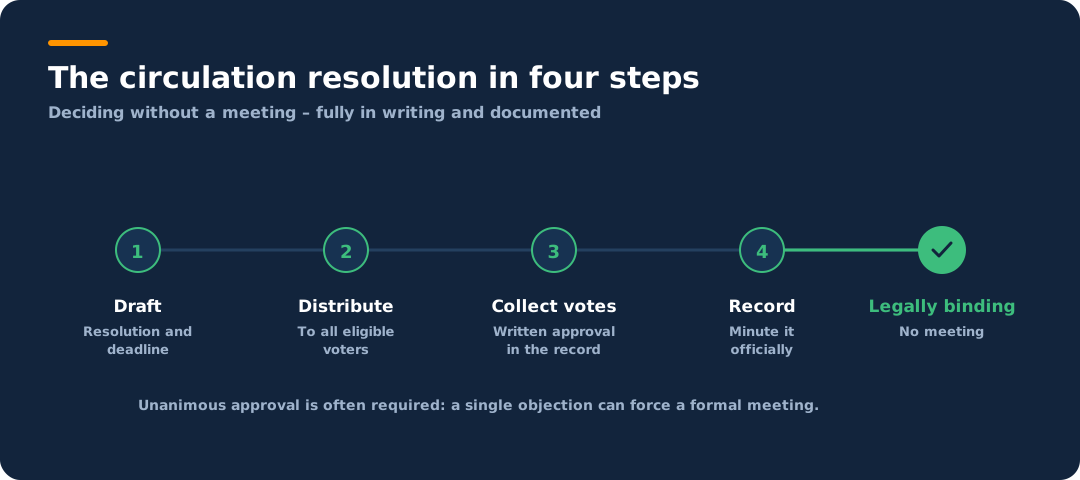
Step 1: Drafting the Resolution
The initiator — a director, board member, or property manager — prepares a written document setting out:
- The proposed decision: a concise statement of what is being decided.
- The rationale: why it is needed, including the legal, financial, or strategic background.
- Supporting documents: financial statements, legal opinions, or reports that give context.
- A response deadline: the window within which participants must vote.
A well-drafted resolution prevents most later arguments.
Step 2: Distributing It to Eligible Participants
The resolution then goes to everyone entitled to vote. How you send it depends on the entity's rules and the law that applies:
- Email: fast and widely accepted, where electronic approval is legally recognised.
- Postal mail: sometimes required for formal decisions, or where governance rules insist on it.
- A contract or document management platform: gives you access control, tracking, and an approval record in one place.
Whichever route you take, confirm that every eligible member actually received it. Failed delivery undermines the validity of the whole resolution.
Step 3: Collecting and Documenting Votes
Each participant approves or rejects in writing. Depending on what the law and the entity's rules allow, that can be:
- A signature on a printed document: still standard for some formal decisions.
- A recognised electronic signature: now the normal route for most entities.
- An email confirmation: sufficient in some cases, where local law and internal policy permit it.
Collect and store every response. If unanimity is required, a single objection stops the resolution.
Step 4: Confirming and Recording the Resolution
Once the approvals are in, record the resolution formally:
- Update the official records: add it to the register of resolutions, minute book, or board records.
- Notify anyone who needs to know: regulators, auditors, or external partners, where required.
- Keep it accessible: you may need to produce it years later for an audit or a dispute.
At that point the circular resolution is binding — no meeting needed, with transparency and accountability intact.
Signing a Circular Resolution Electronically
Most circular resolutions are now signed electronically, which is what makes the process genuinely faster rather than just paperless.
The practical question is which type of signature you need. For the majority of board and shareholder resolutions, an advanced electronic signature — one that identifies the signatory and detects later changes to the document — is both sufficient and far more defensible than a scanned image or a plain email. Where a specific statutory form is prescribed for the underlying decision, you may need a qualified electronic signature instead, so check the requirement for that particular decision rather than assuming one standard covers everything.
Two things matter more than the signature type itself: an audit trail showing who approved what and when, and proof that every eligible participant received the resolution. Both are exactly what gets tested if the resolution is later challenged. Our guide to digital contract signing covers the signature levels in more detail, and you can see how the approval trail works in practice in our platform for managing contracts and approvals.
Advantages & Disadvantages
Advantages
✅ Saves time – Approval without scheduling a meeting, which shortens the whole decision cycle.
✅ No physical presence required – Suits remote teams, international boards, and busy directors.
✅ Efficient for routine or urgent matters – Ideal for straightforward decisions like financial approvals or administrative changes.
Disadvantages
❌ High approval thresholds – Several systems require unanimity. One dissenting member and you are back to convening a meeting.
❌ No real-time discussion – Nothing gets clarified in the moment, which is a genuine drawback for contested or complex matters.
❌ Risk of misunderstanding – Without discussion, members may read the resolution differently from how it was intended.
❌ Not available for every decision – Some matters are reserved by statute or by the articles for a properly convened meeting.
Practical Examples
Example 1: Board Resolution by Circulation – Approving a Bank Mandate
A company needs to update the signatories on its bank account before month end, and the next board meeting is weeks away. The company secretary circulates a draft resolution to all directors with the bank's forms attached, setting a five-day deadline. A majority of the directors entitled to vote approve it electronically, no director requires it to go to a meeting, and the resolution is entered in the register. The mandate is updated without waiting.
Example 2: Private Company – Approving a Capital Increase
A limited company plans to increase its share capital to fund expansion. Rather than convening a shareholders' meeting, the managing director drafts a circular resolution covering:
- The proposed increase
- The reason for it
- Supporting financial documents
- A response deadline
The resolution goes to all shareholders. Once the required threshold is met in writing, the decision is valid and can be filed with the relevant registry.
Example 3: Association – Approving an Urgent Budget Change
A sports association faces unexpected event costs and cannot wait for the next general meeting. The board circulates a written resolution setting out the reason for the adjustment, a breakdown of the new costs, and voting instructions with a deadline. Once the members have signed in favour, the association proceeds.
Example 4: Homeowners' Community – Approving Emergency Repairs
A storm damages a building's roof. Waiting for the next assembly would mean further damage and higher costs. The property manager circulates a resolution stating the extent of the damage, the repair estimate and contractor details, the expected timeline, and how to submit approval. With the owners' written agreement, repairs start immediately.
FAQ
What is a circular resolution?
A circular resolution is a formal decision taken by the members or directors of a company, board, association, or homeowners' community without holding a meeting. The proposed decision is circulated in writing to everyone entitled to vote, and they record their approval in writing. Once the required approvals are in, the resolution binds the entity just as a decision taken at a meeting would.
What does resolution by circulation mean?
It means the same thing as a circular resolution — the decision is passed by sending it round to the people entitled to vote rather than convening a meeting. "Resolution by circulation" is the phrasing used in the Indian Companies Act 2013, where Section 175 sets out the procedure for board resolutions passed this way.
Is a circular resolution legally binding?
Yes, provided the conditions are met: everyone entitled to vote received it, the wording is clear, the votes are properly documented, and the applicable approval threshold is satisfied. The threshold is the part that varies most between jurisdictions and entity types. Some decisions are also reserved by statute or by the entity's articles for a meeting, and cannot be taken by circulation at all.
What majority is needed to pass a resolution by circulation?
It depends on the jurisdiction and the entity. Under Indian law a board resolution by circulation needs approval from a majority of the directors entitled to vote, and any one-third of directors can force it to a meeting instead. UK written resolutions of members follow the ordinary or special resolution threshold. Several other systems, including the German rules for a GmbH, require the agreement of all members. Confirm the threshold before circulating.
Can a circular resolution be signed electronically?
In most cases yes, and it is now the normal practice. An advanced electronic signature is usually sufficient and considerably more defensible than a scanned signature or a plain email reply. Where a specific statutory form applies to the underlying decision, a qualified electronic signature may be required. What matters alongside the signature is a complete audit trail of who approved what and when.
How is a circular resolution different from a written resolution?
They describe the same mechanism, with the label depending on where you are. "Written resolution" is the statutory term in UK company law, "resolution by circulation" in India, "circulating resolution" in Australian practice, and "Umlaufbeschluss" in Germany. The underlying idea is identical: a binding decision taken in writing without a meeting.
Ready for the next step?
Book a demo with our team and see top.legal in action